
The volume and complexity of medical records involved in legal, insurance, and healthcare cases continue to grow. Attorneys handling personal injury and workers’ compensation claims, insurance professionals assessing liability and damages, and healthcare organizations reviewing treatment histories often face thousands of pages of medical documentation.
Manually reviewing these records is time-consuming, expensive, and susceptible to oversight. Critical events can be buried within years of treatment notes, diagnostic reports, physician consultations, hospital records, and medication histories.
This challenge has created growing demand for AI-powered medical record review solutions. One of the most valuable innovations emerging from this transformation is the use of AI-generated medical chronologies.
A well-prepared medical case chronology organizes clinical events into a clear, structured timeline, helping professionals quickly understand the progression of injuries, treatments, diagnoses, and outcomes. When artificial intelligence is combined with expert human review, the process becomes faster, more scalable, and more insightful.
This article discusses how AI medical chronologies are strengthening case review processes and why many organizations are partnering with a specialized medical record review company to leverage this technology effectively.
What Is a Medical Case Chronology?
A medical case chronology is a chronological summary of a patient’s medical history, or a medical timeline creation, relevant to a particular case.
It typically includes:
- Dates of treatment
- Medical providers involved
- Diagnoses
- Procedures and surgeries
- Medications
- Diagnostic testing
- Hospital admissions
- Follow-up care
- Functional limitations
- Significant clinical events
The primary goal of medical record summarization is to transform large volumes of medical documentation into a concise and easily understandable timeline.
Rather than reviewing thousands of pages individually, attorneys, claims professionals, and physicians can quickly identify:
- Key medical events
- Treatment gaps
- Pre-existing conditions
- Injury progression
- Recovery patterns
- Potential causation issues
A well-developed chronology provides the foundation for informed decision-making throughout the case lifecycle.
Why Traditional Medical Chronology Creation Can Be Challenging
Creating a chronology manually requires reviewers to examine every page of medical documentation and extract relevant information.
The medical records analysis process comes with several challenges:
- Large Record Volumes
Complex personal injury and workers’ compensation cases typically involve records from multiple providers spanning several years.
- Time Constraints
Legal and insurance professionals work under strict deadlines that leave little room for lengthy manual reviews.
- Data Fragmentation
Patient information may be spread across:
- Hospitals
- Primary care physicians
- Specialists
- Rehabilitation centers
- Diagnostic facilities
- Pharmacies
- Human Error Risks
Even experienced reviewers can miss critical information when reviewing thousands of pages under time pressure.
These challenges have accelerated interest in AI-driven solutions.
What are AI-generated medical chronologies?
AI-generated medical chronologies are structured timelines created using artificial intelligence to extract, organize, and summarize medical events from patient records. They help attorneys, insurers, and healthcare professionals review complex cases more efficiently while improving access to critical medical information. These can be obtained from companies providing litigation support services.
AI-generated vs. Traditional Medical Chronologies
Organizations evaluating chronology solutions can compare AI-assisted workflows with traditional manual review methods. While both approaches aim to create an accurate medical case chronology, the process, speed, and scalability differ considerably.
| Factor | Traditional Medical Chronology | AI-generated Medical Chronology |
| Review Speed | Manual extraction can take days or weeks for large cases | AI can process thousands of pages within hours |
| Scalability | Resource-intensive for high-volume caseloads | Easily scales across multiple cases |
| Data Extraction | Dependent on manual identification of key events | Automated extraction of dates, diagnoses, procedures, and treatments |
| Consistency | May vary among reviewers | Standardized extraction methodology |
| Pattern Recognition | Requires extensive reviewer effort | Can identify recurring trends and treatment patterns more efficiently |
| Cost Efficiency | Higher labor requirements | Reduced administrative effort and faster turnaround |
| Human Clinical Insight | Strong | Strong when combined with expert review |
| Accuracy | High with experienced reviewers | High when AI output is validated by clinical experts |
The most effective approach is not AI alone versus human reviewers. Instead, leading organizations are adopting a hybrid model that combines AI-powered case analysis and extraction with expert medical validation. This approach delivers the speed of automation while preserving the clinical judgment necessary for high-stakes legal and insurance matters.
How AI Generates Medical Chronologies
Modern AI medical record review systems use technologies such as NLP, Machine Learning, OCR, and Clinical Entity Recognition to automate medical records analysis and support faster chronology development. These technologies can identify and extract relevant information from structured and unstructured medical records.
The process generally involves:
Step 1: Record Digitization
Scanned documents are converted into searchable text using OCR technology.
Step 2: Data Extraction
AI identifies:
- Dates
- Diagnoses
- Procedures
- Medications
- Providers
- Laboratory findings
- Imaging studies
Step 3: Event Classification
Medical events are categorized according to their clinical significance.
Step 4: Timeline Construction
Events are organized into a chronological framework.
Step 5: Human Validation
Experienced medical reviewers verify accuracy, context, and completeness.
This hybrid approach combines AI speed with human clinical judgment.
Key Benefits of AI Medical Chronology Creation
1. Faster Case Review
Speed is one of the most significant advantages.
One of the key benefits of using AI to analyze large volumes of medical records is the ability to process thousands of pages in a fraction of the time required for traditional review methods. Research published by organizations studying healthcare AI applications consistently demonstrates that automated document processing can significantly reduce administrative review burdens while improving operational efficiency.
For attorneys and insurers, this translates into:
- Faster case preparation
- Quicker settlement evaluations
- Improved litigation readiness
- Reduced turnaround times
2. Improved Information Accessibility
Medical records contain highly technical terminology and fragmented clinical narratives. AI-generated chronologies organize information into a clear sequence of events, helping stakeholders understand cases more efficiently.
This accessibility helps:
- Attorneys prepare arguments
- Claims professionals assess exposure
- Physicians conduct independent reviews
- Expert witnesses analyze case histories
3. Enhanced Pattern Recognition
AI systems can identify trends that may otherwise require extensive manual review. Examples include:
- Recurring symptoms
- Treatment progression
- Medication changes
- Chronic disease development
- Repeated provider visits
Pattern recognition supports deeper case analysis and helps uncover medically relevant insights.
4. Greater Consistency
Manual review approaches can vary among reviewers. AI-driven extraction follows predefined methodologies, helping standardize chronology development.
When combined with expert quality assurance, organizations can achieve greater consistency across multiple cases.
5. Better Identification of Critical Events
AI tools can highlight:
- Emergency department visits
- Surgical interventions
- Diagnostic findings
- Significant treatment milestones
- Hospital admissions
With this, reviewers can focus on events that may influence liability, causation, damages, or treatment necessity.
Real-world Example: Accelerating Case Review with AI-generated Chronologies
Consider a hypothetical personal injury case involving a claimant with a five-year treatment history across multiple healthcare providers.
The case file contains:
- 8,000+ pages of medical records
- Hospital records from three facilities
- Orthopedic consultations
- Diagnostic imaging reports
- Physical therapy documentation
- Prescription histories
Using a traditional review process, a reviewer may spend several days extracting key events and developing a comprehensive chronology.
With an AI-assisted workflow, records are first processed through intelligent extraction tools that identify:
- Treatment dates
- Diagnoses
- Surgical procedures
- Imaging studies
- Medication histories
- Provider encounters
The AI-generated timeline is then reviewed and validated by medical experts.
As a result, reviewers can focus more time on analyzing causation, treatment progression, and case-specific issues rather than manually locating information. This significantly shortens review cycles and allows attorneys and claims professionals to access actionable insights sooner.
For organizations handling large volumes of cases, these efficiency gains can translate into faster litigation preparation, improved claims management, and more effective allocation of review resources.
Why Human Oversight Remains Essential
Despite its advantages, AI should not be viewed as a replacement for medical expertise. Medical records may contain:
- Ambiguous language
- Context-dependent findings
- Handwritten notes
- Complex causation issues
Human reviewers provide:
- Clinical Interpretation
Medical professionals understand the significance of diagnoses and treatment decisions.
- Contextual Analysis
Not all extracted information carries equal relevance.
- Quality Assurance
Experts verify chronology accuracy and completeness.
- Case-specific Customization
Chronologies can be tailored to litigation, insurance, or clinical objectives.
This is why leading medical record review services rely on a human-in-the-loop model.
Applications across Legal and Insurance Cases
Personal Injury Litigation
For attorneys handling injury claims, AI medical record review for personal injury cases provides a faster way to:
- Track injury progression
- Identify treatment timelines
- Assess damages
- Prepare for depositions
Workers’ Compensation Cases
Chronologies assist in:
- Determining causation
- Evaluating return-to-work status
- Reviewing treatment histories
- Monitoring claim development
Medical Malpractice Reviews
Reviewers can identify:
- Treatment sequences
- Clinical decision points
- Potential deviations from standards of care
Insurance Claims Management
Claims professionals use chronologies to:
- Evaluate claim validity
- Assess treatment appropriateness
- Identify fraud indicators
- Support reserve calculations
The Role of a Medical Record Review Company
Implementing AI effectively requires more than software alone. A reputable AI-powered medical record review company combines advanced technology, clinical expertise, and quality assurance processes to deliver accurate and defensible review outcomes.
Technology Infrastructure
Secure platforms for record ingestion, processing, and analysis.
Clinical Expertise
Experienced nurses, physicians, and medical reviewers who validate findings.
Compliance Support
Protection of sensitive health information through HIPAA-compliant processes and robust security controls.
Customized Deliverables
Tailored chronologies designed for:
- Attorneys
- Insurers
- Healthcare providers
- Independent medical experts
The combination of technology and human expertise delivers the greatest value.
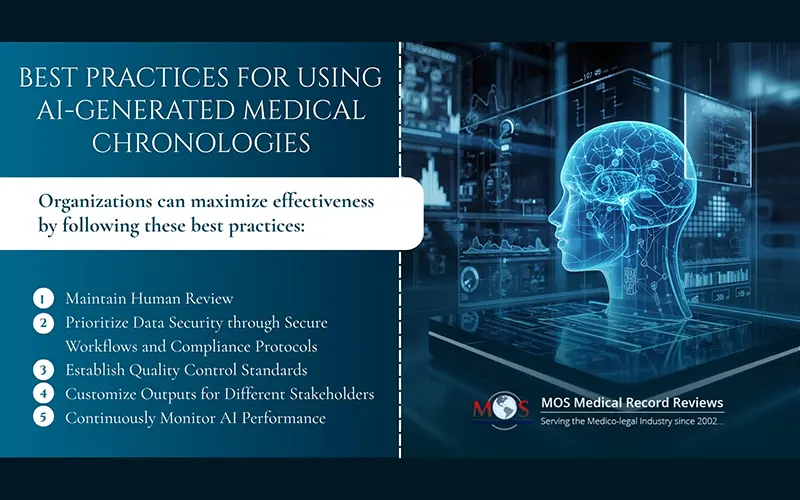
Best Practices for Using AI-generated Medical Chronologies
Organizations can maximize effectiveness by following these best practices.
Maintain Human Review
Every AI-generated chronology should undergo expert validation.
Prioritize Data Security
Medical information must be protected through secure workflows and compliance protocols.
Establish Quality Control Standards
Standardized review processes help ensure consistency and accuracy.
Customize Outputs
Different stakeholders require different levels of detail and analysis.
Continuously Monitor AI Performance
Regular auditing helps identify gaps and improve system performance over time.
Research and Industry Evidence Supporting AI-powered Case Review
Growing evidence suggests that AI can significantly improve information processing and reduce administrative workloads in healthcare and related industries.
According to a 2025 survey highlighted by the American Medical Association (AMA), 57% of physicians identified reducing administrative burdens through automation as the most valuable opportunity for AI adoption. This reflects a growing recognition that AI can help professionals spend less time managing documentation and more time focusing on higher-value analytical work.
Research published in 2025 on AI-assisted documentation tools found measurable reductions in administrative workload, including decreases in documentation time and after-hours work. Some implementations reported documentation-related time savings exceeding 20%, demonstrating AI’s ability to streamline information-intensive workflows.
Industry research from McKinsey also suggests that healthcare organizations are increasingly deploying generative AI to improve operational efficiency, automate repetitive processes, and unlock value from large volumes of unstructured data. AI is rapidly moving from experimental pilots to enterprise-scale implementation across healthcare workflows.
Additionally, the McKinsey analysis indicates that healthcare employees may spend 20% to 30% of their workday on non-productive administrative activities. AI-powered automation presents a significant opportunity to reduce these burdens and improve operational efficiency.
These findings are particularly relevant to medical record review services, where professionals routinely analyze extensive volumes of documentation. By automating data extraction and chronology development, AI can help reduce review time while improving accessibility to critical case information.
Future Trends in AI-Powered Medical Record Review
The future of AI in medical record review continues to evolve rapidly.
Emerging capabilities include:
- Predictive Case Insights
AI may increasingly help identify risk factors and likely case outcomes.
- Advanced Clinical Entity Recognition
Systems are becoming better at understanding complex medical terminology.
- Automated Case Summaries
AI-generated summaries will become more comprehensive and context-aware.
- Multimodal Data Analysis
Future solutions may integrate:
- Medical records
- Imaging reports
- Laboratory data
- Wearable device information
- Enhanced Legal Analytics
AI may support deeper analysis of medical evidence relevant to litigation strategies.
Organizations that adopt these innovations strategically will be better positioned to handle growing case complexity.
AI-generated Medical Chronologies Offer a Powerful Solution
As medical records become increasingly voluminous and complex, organizations need more efficient ways to extract actionable insights.
AI-generated medical chronologies offer a powerful solution by transforming extensive documentation into structured, searchable, and easy-to-understand timelines. They accelerate review processes, improve information accessibility, enhance consistency, and help identify critical medical events.
However, the greatest value emerges when artificial intelligence is combined with expert human oversight. A trusted medical record review company can leverage advanced technology while ensuring the accuracy, context, and quality necessary for high-stakes legal, insurance, and healthcare decisions.
For organizations seeking more efficient medical record review services, AI-powered chronology development is no longer simply an emerging innovation—it is rapidly becoming a strategic advantage.
FAQs
What is a medical case chronology?
A medical case chronology is a structured timeline that organizes a patient’s medical events, treatments, diagnoses, procedures, and healthcare encounters in chronological order.
How does AI help create medical chronologies?
AI uses technologies such as natural language processing, machine learning, and OCR to extract relevant information from medical records and organize it into a chronological timeline.
Are AI-generated medical chronologies accurate?
AI can significantly improve efficiency, but accuracy is highest when AI-generated outputs are reviewed and validated by experienced medical professionals.
Who benefits from medical chronology services?
Attorneys, insurance companies, healthcare providers, independent medical examiners, legal nurse consultants, and claims professionals can utilize medical chronology services.
Why should organizations work with a medical record review company?
A specialized medical record review company combines advanced technology, clinical expertise, quality assurance processes, and compliance safeguards to produce reliable case review deliverables.
Can AI-generated medical chronologies be used in personal injury and workers’ compensation cases?
Yes. AI-generated chronologies are widely used to analyze treatment histories, establish timelines, evaluate causation, assess damages, and support litigation and claims management activities. Providers of medical chronology services for attorneys can provide the required customized support.