
Law firms and litigation teams manage large volumes of documents that must be organized into clear timelines for case preparation. Manually reviewing records, identifying key events, and building structured chronologies that support arguments and case strategies requires significant time and effort. This is why many firms are adopting timeline creation with AI legal case chronology solutions to automate the process. By using artificial intelligence, professionals can quickly extract important dates, organize case events, and generate accurate timelines from complex records. AI legal case chronology tools help improve efficiency, reduce manual workload, and support faster analysis across litigation matters.
Understanding AI Legal Case Chronology
An AI legal case chronology is prepared using artificial intelligence to review case documents, identify important events, extract dates, and organize information into a structured timeline. Instead of manually sorting through thousands of pages of records, AI systems quickly analyze documents and produce chronological summaries that are easier to review and interpret.
Traditionally, chronologies require significant attorney or paralegal involvement. Teams must review emails, depositions, contracts, medical records, court filings, and other evidence to understand how events unfolded over time. This manual process is not only time-consuming but also prone to human error and inconsistencies. With the help of AI-powered legal timelines, firms can automate much of this work while maintaining accuracy and consistency across matters. AI tools can identify patterns, highlight missing information, and organize records into searchable timelines that improve case analysis and preparation.
The Growing Importance of Timeline Automation
As litigation becomes more document-heavy, professionals face increasing pressure to manage information efficiently. Large matters may involve tens of thousands of pages of evidence, making traditional chronology creation slow and resource-intensive. This is where timeline creation with AI legal case chronology solutions delivers strong value. Automated systems can process vast amounts of information in a fraction of the time required for manual review. Professionals can then focus more on strategy, analysis, and client communication rather than repetitive administrative tasks.
How AI Automates Case Chronology Creation
AI-powered systems use technologies such as natural language processing (NLP), machine learning, and intelligent data extraction to review and structure documents. These tools scan records, identify relevant dates, recognize key events, and categorize information automatically.
For example, in a medical malpractice matter, AI can review medical records and extract treatment dates, diagnoses, physician notes, surgeries, and follow-up visits. The system then organizes these events into a clear timeline for review and analysis.
Similarly, in employment disputes, AI tools can identify hiring dates, disciplinary actions, emails, policy updates, and termination records to build a detailed chronology of workplace events. The automation process typically includes:
- Extracting dates and events from documents
- Identifying key individuals and entities
- Organizing events in chronological order
- Flagging inconsistencies or missing data
- Creating searchable and editable timelines
- Summarizing large document sets
By automating these tasks, teams can significantly reduce the time spent on document organization and chronology development.
Benefits of Automating Timeline Creation with AI Legal Case Chronology
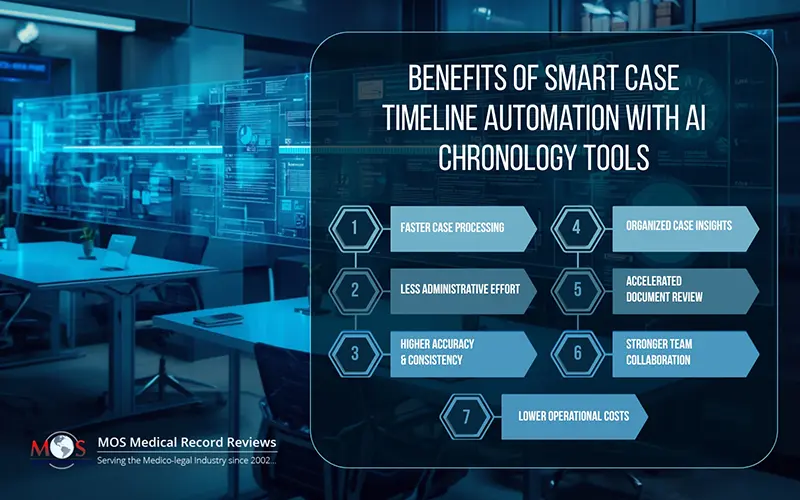
There are several benefits of automating timeline creation with AI legal case chronology solutions for firms, attorneys, and litigation support teams.
- Improved Efficiency: AI systems process large volumes of documents far faster than manual review, speeding up case preparation.
- Reduced Manual Work: Automation removes repetitive tasks, enabling professionals to focus on higher-value analysis.
- Enhanced Accuracy: AI helps reduce the risk of missing important events or dates, improving consistency in complex matters.
- Better Case Organization: AI-powered timelines provide structured and searchable chronologies that improve access to information.
- Faster Document Review: Integration with AI for legal document review enhances workflow efficiency by identifying and organizing relevant materials quickly.
- Improved Collaboration: Centralized timelines enable teams to work together more effectively using standardized information.
- Cost Savings: Reduced manual effort leads to lower operational costs and more efficient resource use.
Applications across Practice Areas
The use of AI legal case chronology solutions extends across multiple practice areas:
- Personal Injury Matters: Organizes accident reports, medical records, insurance documents, and treatment histories into structured timelines.
- Medical Malpractice Cases: Helps analyze patient histories, treatment delays, and clinical documentation more efficiently.
- Employment Disputes: Organizes employee records, communications, disciplinary actions, and policy changes.
- Commercial Disputes: Reviews contracts, emails, invoices, and transaction records to map corporate events.
- Insurance Defense: Assists in reviewing claims, medical records, and case documentation more efficiently.
The Future of AI-powered Timelines
The future of AI-powered legal timelines is expected to become even more advanced as artificial intelligence evolves. Emerging systems are increasingly capable of understanding context, identifying relationships between events, and generating predictive insights based on past matters. Future developments may include:
- Real-time timeline updates during active cases
- Predictive analysis using AI-generated chronologies
- Advanced visualization tools for courtroom presentation
- Greater integration with case management platforms
- Multilingual document analysis capabilities
As adoption grows, AI-driven chronology solutions are likely to become a standard part of modern case workflows.
Timeline creation with AI legal case chronology solutions is transforming how complex case information is organized and analyzed. By automating document review, extracting key events, and generating structured timelines, these tools help professionals save time, reduce errors, and improve overall efficiency.
Keep Reading: How Legal Case Chronology Tools Help Develop the Best Case Strategy
The growing use of AI legal case chronology, AI-powered legal timelines, and AI for legal document review reflects a broader shift toward smarter and more efficient workflows. Understanding how AI automates legal case chronology creation and recognizing the benefits of automating timeline creation with AI legal case chronology can help firms stay competitive in an increasingly technology-driven environment.