
The legal industry is undergoing a major transformation as Artificial Intelligence (AI) increasingly reshapes how law firms manage complex case reviews. Among the most significant developments is the growing adoption of AI medical chronology services for personal injury, medical malpractice, workers’ compensation, and mass tort litigation. For decades, attorneys and paralegals relied on manual review processes to organize thousands of pages of medical records into coherent timelines. Though effective, traditional methods were time-consuming, labor-intensive, and vulnerable to human error. Now, AI-powered solutions are changing that equation by enabling faster, more accurate, and more scalable case analysis.
As U.S. law firms handle rising caseloads and increasingly complex medical documentation, the role of medical chronology services has evolved from a support function into a strategic advantage. Firms are now leveraging AI-assisted technologies to improve efficiency, strengthen litigation strategies, and accelerate settlement preparation without compromising compliance or accuracy.
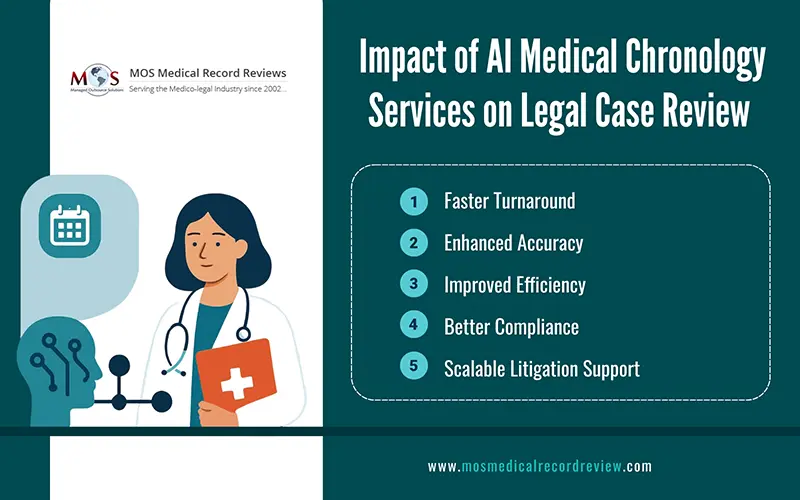
According to industry reports, AI-powered medical case chronology tools can reduce medical record review time by up to 72% while significantly improving workflow efficiency for legal teams.
This post explores how AI-assisted medical chronology services are transforming legal case review, the benefits and limitations of automation, and what U.S. law firms should consider when selecting a trusted medical record review company.
What Constitutes AI Medical Chronology Services?
Medical chronology services involve the systematic organization of medical records into a date-wise timeline that highlights diagnoses, treatments, physician visits, surgeries, medications, imaging studies, and outcomes relevant to a legal case.
Traditionally, legal teams manually reviewed medical documents to identify:
- Injury progression
- Treatment gaps
- Pre-existing conditions
- Causation evidence
- Billing patterns
- Physician observations
AI has now automated many of these repetitive review tasks, ensuring effective and time-saving legal AI solutions.
Modern AI-powered medical record review for attorneys use machine learning, natural language processing (NLP), and intelligent document recognition to review voluminous medical data within minutes. These systems extract relevant clinical events, identify patterns, categorize records, and generate chronological summaries that support litigation preparation.
Purpose-built legal AI platforms can process extensive medical files rapidly while linking findings back to source records for validation and traceability. AI-powered legal workflows ensure the following benefits for law firms:
- Faster case intake
- Reduced administrative burden
- Improved document accessibility
- Enhanced litigation readiness
Why U.S. Law Firms Are Adopting AI Medical Record Review
The volume of medical documentation involved in modern litigation has increased significantly. A single personal injury or medical malpractice case may involve thousands of pages of records from multiple healthcare providers.
Manual review creates several operational challenges:
- High labor costs
- Long turnaround times
- Reviewer fatigue
- Inconsistent summaries
- Missed clinical details
On an average, attorneys and paralegals may spend 40–80 hours reviewing moderately complex medical cases manually. This is why many firms are turning toward AI-assisted medical chart review solutions.
What Are the Key Drivers behind AI Adoption?
- Faster Case Evaluation
AI significantly accelerates case review timelines by organizing records and generating summaries automatically.
Some AI platforms reportedly reduce medical record chronology preparation time by as much as 80–95%, enabling firms to move cases faster from intake to litigation strategy.
This speed can be especially valuable in:
- Personal injury case review
- Medical malpractice litigation support
- Workers’ compensation medical review
- Mass tort reviews
- Improved Accuracy in Medical Record Analysis
Large record sets often contain duplicate records, conflicting physician notes, or buried critical evidence. Manual chronologies may overlook substantial amounts of case-relevant information.
AI systems can detect:
- Missing documentation
- Treatment inconsistencies
- Chronological gaps
- Repeated diagnoses
- Hidden clinical correlations
When combined with human quality review, AI-assisted workflows can improve the reliability of medical chart review and legal case preparation.
- Scalability for Growing Caseloads
One major challenge for litigation firms is scaling operations without proportionally increasing staffing costs.
AI-powered medical chronology services enable firms to:
- Handle larger case volumes
- Reduce backlog
- Improve turnaround times
- Optimize attorney productivity
This operational scalability is becoming increasingly important for firms managing high-volume litigation.
How AI Enhances Medical Chronology Workflows
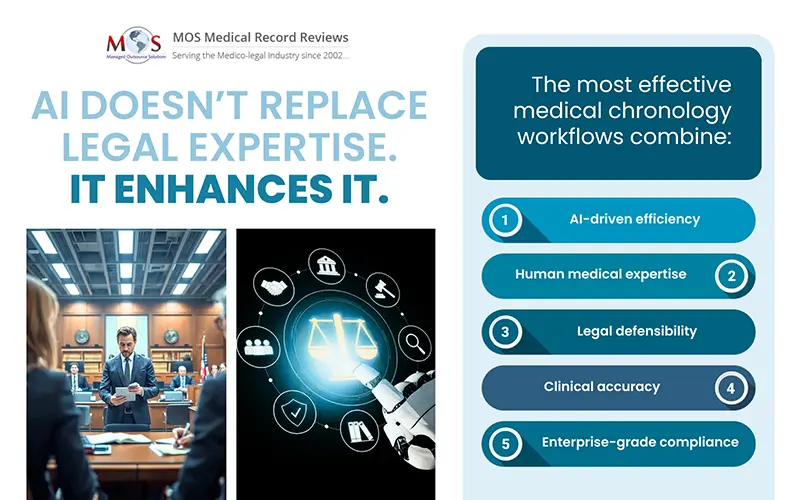
AI does not replace legal expertise. Instead, it enhances the efficiency of document-intensive workflows. A modern medical record review company using AI may incorporate:
- Intelligent OCR and Data Extraction
AI tools convert scanned medical records into searchable, structured text.
This helps legal teams quickly identify:- Provider names
- Dates of service
- ICD/CPT codes
- Medications
- Procedures
- Diagnostic findings
- Automated Timeline Generation
AI platforms automatically organize clinical events chronologically, enabling attorneys to quickly understand the progression of injuries and treatments.
- Clinical Summarization
Advanced systems generate concise summaries of:
- Hospitalizations
- Surgeries
- Rehabilitation
- Diagnostic imaging
- Long-term treatment plans
- Duplicate Detection
AI can identify overlapping or redundant records, reducing review clutter and improving efficiency.
- Evidence Linking
Many modern platforms provide “click-to-evidence” capabilities that connect summaries directly to source documents, supporting defensibility and auditability.
Benefits of AI Medical Chronology Services for Law Firms
Enhanced Attorney Productivity
By automating repetitive administrative tasks, attorneys can focus more on:
- Case strategy
- Depositions
- Settlement negotiation
- Trial preparation
- Client communication
This improves overall firm productivity and operational efficiency.
Reduced Turnaround Times
Faster chronology creation enables:
- Quicker demand letter preparation
- Faster expert review
- Accelerated settlement discussions
- Improved client responsiveness
In competitive litigation environments, speed becomes a strategic differentiator.
Better Case Insights
AI-assisted analysis can reveal:
- Injury progression patterns
- Pre-existing conditions
- Delayed treatment issues
- Compliance gaps
- Alternative causation factors
These insights help strengthen legal arguments and improve risk assessment.
Cost Efficiency
Manual review is expensive and resource-intensive. AI-assisted medical chart review reduces the number of billable hours spent on administrative review tasks while improving consistency across cases.
Industry estimates suggest AI-driven chronologies can significantly lower operational review costs for legal teams.
Standardization across Cases
One challenge with manual review is inconsistency between reviewers. AI-assisted workflows create:
- Standardized formats
- Uniform terminology
- Consistent chronology structures
- Predictable reporting quality
This consistency improves collaboration between attorneys, paralegals, experts, and insurers.
Challenges and Limitations of AI in Medical Chronology Review
Despite its advantages, AI adoption also presents challenges that law firms must address carefully.
- AI Cannot Replace Human Judgment
AI tools are highly effective at organizing and extracting data, but legal interpretation still requires human expertise. Clinical nuance, causation analysis, and litigation strategy remain dependent on experienced reviewers.
This is why many successful firms use a “human-in-the-loop” approach where AI-generated chronologies are validated by trained professionals.
- Risk of Hallucinations or Misinterpretation
AI systems may occasionally:
- Misclassify records
- Misinterpret handwritten notes
- Generate inaccurate summaries
- Miss contextual subtleties
Without human validation, these errors could affect litigation outcomes.
- Data Security and HIPAA Compliance
Medical records contain highly sensitive Protected Health Information (PHI). A trusted medical record review company must maintain:
- HIPAA compliance
- Secure cloud infrastructure
- Encryption protocols
- Access controls
- Audit trails
Law firms should carefully evaluate vendor security standards before outsourcing AI-assisted reviews.
- Need for Explainability
Legal workflows require transparency. AI-generated summaries must be:
- Traceable
- Verifiable
- Auditable
- Explainable
Firms increasingly prefer platforms that provide evidence-linked summaries rather than “black-box” outputs.
The Role of Human Expertise in AI-assisted Medical Chart Review
The most effective model is not AI alone; it is AI combined with skilled medical and legal reviewers.
Human reviewers add value through:
- Clinical interpretation
- Quality assurance
- Legal relevance assessment
- Contextual understanding
- Error correction
This hybrid approach combines:
- AI speed and scalability
- Human analytical expertise
- Legal defensibility
For many U.S. law firms, partnering with an outsourced medical record review company for law firms that offers HIPAA-compliant medical review and experienced human oversight provides the ideal balance between efficiency, compliance, and accuracy.
Key Features Law Firms Should Look for in AI Medical Chronology Services
When evaluating vendors, law firms should consider several factors.
Accuracy and Validation Processes
Ask:
- Is there human quality review?
- Are summaries verified?
- Is evidence traceable to source documents?
HIPAA and Data Security Compliance
Ensure the provider offers:
- HIPAA-compliant workflows
- Secure file transfer
- Encryption standards
- SOC 2 compliance where applicable
Customization Capabilities
Different cases require different chronology formats. The ideal provider should support:
- Attorney-specific templates
- Specialty-focused chronologies
- Custom reporting structures
Turnaround Time
Fast turnaround remains a major competitive advantage in litigation support.
Scalability
The provider should be capable of handling:
- Large record volumes
- Multi-plaintiff litigation
- Mass tort cases
- Ongoing high-volume review projects
Human Oversight
The best outcomes usually come from AI-assisted workflows supervised by trained medical reviewers.
Future Trends in AI-powered Medical Record Review
The future of medical chronology services will likely involve even greater automation and intelligence. Emerging trends include:
- Predictive case analytics
- AI-assisted causation analysis
- Automated demand package generation
- Real-time litigation dashboards
- Integrated legal workflow automation
The global healthcare AI market is projected to grow substantially over the coming years, reflecting increased adoption across legal, insurance, and healthcare industries. As technology advances, law firms that embrace AI-assisted review processes may gain significant operational and competitive advantages.
Why Human-AI Collaboration Is the Future of Legal Medical Review
AI is redefining how law firms approach medical record analysis. However, the true value of AI lies not in replacing professionals, but in enhancing human expertise.
By automating repetitive review tasks, AI enables attorneys and medical reviewers to focus on:
- Strategic analysis
- Case evaluation
- Litigation planning
- Client advocacy
The result is a more efficient, scalable, and insight-driven approach to legal case review.
For U.S. law firms managing complex litigation, AI-driven medical chronology services and AI-assisted case review are becoming essential components of modern legal operations. Yet the most effective solutions remain those that combine advanced technology with experienced human oversight.
A trusted medical record review company that provides AI medical chronology services for U.S. law firms integrates AI responsibly to help firms improve speed, strengthen accuracy, maintain compliance, and deliver stronger litigation outcomes. As the legal industry continues evolving, firms that adopt intelligent, explainable, and human-supervised medical chart review workflows will be better positioned to manage growing caseloads and deliver exceptional client results.