
A medical chronology provides a brief, accurate, and informative summary of a patient’s treatment history. Attorneys handling multiple cases rely on these reports to understand the key facts relevant to litigation. They gain a clear view of what happened to the plaintiff-the nature and extent of the injury or illness, the care provided, and how the condition relates to the accident or incident. A well-prepared timeline from a professional medical records review service saves them valuable time spent sifting through large volumes of documentation. Such reports are also valuable for insurance claims adjusters, as they can help in evaluating claims and negotiating settlements before a lawsuit is filed. If settlement is not reached, the patient record timeline serves as an important resource when preparing for depositions or trials. Now AI-assisted solutions are available that help create accurate and reliable medical chronologies.
How AI Enhances Medical Chronologies in Legal Cases
In the modern legal landscape, the shift from manual to AI-powered medical record review has redefined the accuracy and speed of medical chronologies. AI doesn’t just list dates – it transforms raw data into a strategic asset through several key enhancements:
- NLP-powered extraction: Natural language processing can quickly identify dates, diagnoses, procedures, and test results across thousands of pages.
- Smart sequencing: AI handles chronological ordering with high precision, accurately interpreting medical events even when they are buried within complex summaries.
- Gap detection: Missing records or inconsistencies are flagged automatically, reducing the risk of overlooked details.
- Hyper linking: Auto-generated links connect each entry to its source document, making navigation seamless.
- Scalability: For high-volume cases, AI reduces turnaround time and minimizes human error, ensuring consistency across multiple chronologies.
This integration of AI ensures that attorneys and insurers receive timelines that are not only accurate but also faster to prepare and easier to use in litigation or settlement discussions.
Now let us discuss the components of a medical case chronology.
What to Include in a Medical Case Chronology
If you are developing a legal case chronology or a medical record timeline, there are certain components that should be necessarily included.
- Date of injury (DOI) and cause of the injury
- Date of admission and time of admission
- Name of the healthcare provider(s)/facility(ies)
- Medical history
- Diagnostic testing, diagnosis, and imaging results
- All relevant clinical encounters and treatment – treatment providers and dates of treatment
- Treatment plan that includes diagnostic details, prescriptions, and referrals
- Hospital visit/stay records as well as those of subsequent treatment by physicians/physical therapists
- Prognosis (possibility of recovery)
- Permanent disability (if any)
- Future medical treatment necessary (if any)
It is best to include even minor details in the medical chronology report. Seemingly minor details and disputed information also may be useful when preparing the case strategy to prove liability, causation, and damages. Missing records or data must also be highlighted in case that may prove useful at a later stage. If any non-clinical information that is relevant is found in the records, it must be included in the report because it could help prove causation.
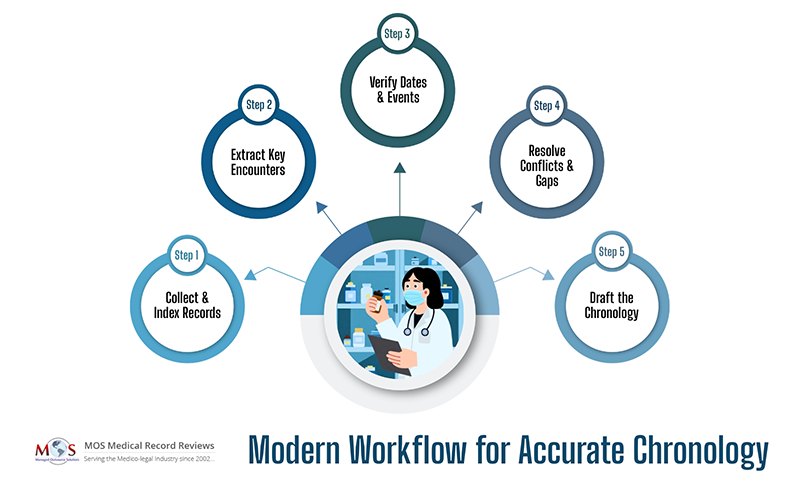
Step-by-Step Process for Preparing a Medical Case Chronology
Step 1: Collect & Index Records
Gather all relevant clinical documents from various providers and facilities. Indexing medical records ensures that the massive volume of data is organized and searchable from the start.
Step 2: Extract Key Encounters
Identify every clinical milestone, including the initial ER visit, diagnostic imaging results, surgical procedures, and follow-up consultations.
Step 3: Verify Dates & Events
Cross-reference extracted data against source records to ensure that the timeline of treatment is factual and accurate.
Step 4: Resolve Conflicts & Gaps
Analyze the timeline for missing information or contradictory statements between different healthcare providers.
Step 5: Draft the Chronology
Compile the verified data into a final, polished report that outlines the patient’s healthcare journey in a clear, narrative-driven format.
Medical Case Chronology Preparation – Points to Note
- Start preparing the chronology immediately: Facts are crucial to a legal or medical case chronology. Therefore, to ensure that even minor facts are not lost, you have to start writing the chronology report immediately. Any delay could result in loss of information.
- Medical record retrieval: Once the required medical records are identified, the respective medical record custodians have to be identified so that the medical record release request can be sent to them.
- Medical record organization and review: The medical records are sorted and categorized to facilitate their review.
- Medical case chronology and summary preparation: An easy-to-understand report that highlights all important aspects in the plaintiff’s medical chart is prepared. The following points may be noted to ensure maximum value for the chronology:
- Important areas of the summary may be highlighted
- Delete all duplicate records and create a log of the deleted records
- Prepare the chronology in WORD or PDF format. Hyperlinks can be included for quick navigation to the source records. Medical terms can be defined, if required.
Medical Case Chronology – Much More Than a Timeline
A healthcare chronology is not just a timeline – it’s a strategic narrative that can influence the outcome of a case. The way events are presented shapes how attorneys, insurers, and juries understand the plaintiff’s medical journey. Here are some key points to note.
- Efficiency and clarity: A well-structured chronology condenses complex clinical records into a clear, concise format. Legal teams save time and resources by quickly grasping the key facts without sifting through thousands of pages.
- Cause and progression: The chronology shows how the injury occurred, how the condition developed, and whether recovery was steady or interrupted by setbacks.
- Negotiation leverage: Presenting a comprehensive health history strengthens settlement negotiations. A clear chronology can help attorneys argue damages more effectively and push toward policy limits.
- Trial readiness: An organized chronology makes it easier to present clinical evidence to judges and juries. This enhances credibility and ensures the narrative is persuasive in court.
- Attention to detail: Every detail matters — thorough chronologies prevent overlooked facts, build stronger arguments, and provide the foundation for a compelling case strategy.
By transforming raw medical data into a persuasive narrative, a strong chronology becomes more than evidence – it becomes a roadmap that guides strategy, negotiation, and trial preparation.
Common Mistakes When Preparing a Chronology and How to Avoid Them
Even experienced legal teams can make errors when compiling medical chronologies. These mistakes weaken credibility, prolong cases, and risk unfavorable outcomes. The most frequent pitfalls include:
- Incomplete medical record: Missing hospital visits, therapy notes, or lab reports leave gaps in the timeline.
- Solution: Retrieve records from every provider and verify completeness before starting.
- Incorrect sequencing: Wrongly arranged dates or overlooked encounters distort the clinical
- Solution: Use systematic indexing or AI-assisted sequencing to ensure accuracy.
- Overlooking minor details: Small notes on symptoms, medications, or follow-ups may seem trivial but prove significant in litigation.
- Solution: Include all details, even those that appear insignificant.
- Unresolved conflicts: Contradictions between records such as differing diagnoses or treatment dates — undermine credibility.
- Solution: Flag inconsistencies and clarify them before finalizing the chronology.
- Excessive jargon: Chronologies filled with clinical shorthand or unexplained abbreviations confuse non-medical readers.
- Solution: Expand abbreviations and simplify terminology for attorneys and insurers.
- Poor formatting: Disorganized layouts or lack of hyperlinks make chronologies difficult to navigate.
- Solution: Present reports in clear formats (Word/PDF) with hyperlinks to source records.
- Lack of quality control: Errors that could have been caught in review weaken the report.
- Solution: Implement multi-level QA or hybrid AI-human review for accuracy.
Avoiding these mistakes ensures chronologies remain defensible, efficient, and persuasive in both settlement and trial.
A well-prepared case chronology is a time-, cost-, and labor-saving tool for attorneys, often helping to resolve matters quickly or serve as evidence at trial. Rather than preparing these reports in-house, attorneys, insurers, and arbitrators can rely on professional medical record review services to obtain accurate, timely, and easy-to-use summaries.
Since most legal staff are not trained in healthcare, professionally created case chronologies offer a clear, fact-based interpretation of events. Complex terminology is simplified, and all abbreviations are expanded for better understanding. With AI-enabled review, these chronologies gain added precision and speed – automating extraction, sequencing, and gap detection while still being validated by expert reviewers. This hybrid approach ensures attorneys receive timelines that are both technologically advanced and legally reliable.
See AI in Action: Free Chronology Demo
Experience how AI-powered medical record review can transform your case preparation.
Quick FAQ
Attorneys often have recurring questions about medical chronologies. Addressing these upfront helps clarify their value and use:
Q1: How detailed should a chronology be?
Every relevant detail should be included — even minor notes or disputed information — because small facts can become critical in proving liability or damages.
Q2: Can AI really improve accuracy?
Yes. AI tools can extract dates, diagnoses, and treatments faster, sequence events correctly, and flag gaps or inconsistencies that manual review might miss.
Q3: What’s the difference between a chronology and a summary?
A chronology is a timeline of events, while a summary highlights key findings. Together, they provide both detail and context for legal teams.
Q4: How long does it take to prepare a chronology?
Manual preparation can be time-intensive, but AI-enabled services significantly reduce turnaround time while maintaining accuracy.