

In personal injury litigation, medical records often form the foundation of a case, but they rarely arrive in a format that supports fast or accurate analysis.
These records document the injury itself, the progression of symptoms, treatment history, physician observations, diagnostic findings, medications, rehabilitation efforts, and long-term outcomes.
However, interpreting medical documentation is rarely straightforward.
A single personal injury case may involve thousands of pages of records spread across:
- Hospitals
- Emergency departments
- Specialists
- Physical therapy providers
- Imaging centers
- Primary care physicians
- Rehabilitation facilities
When handwritten physician notes, duplicate records, inconsistent documentation, missing files, and multi-year treatment histories are added into the mix, even experienced legal teams may struggle to organize and analyze the information efficiently.
This is where medical chronology services provide measurable value.
By transforming large volumes of medical documentation into structured, date-sequenced timelines, medical chronologies help personal injury attorneys:
- Evaluate cases more efficiently
- Identify critical medical events faster
- Present evidence more clearly during litigation
As documentation complexity continues to grow, medical chronology preparation is becoming a core component of modern personal injury case management.
What Is a Medical Chronology?
A medical chronology is a date-sequenced timeline that organizes a patient’s medical history directly from source records.
It systematically documents:
- Diagnoses
- Treatments
- Procedures
- Physician encounters
- Medications
- Diagnostic testing
- Clinical observations
- Rehabilitation history
- Follow-up care
Instead of reviewing records page by page, attorneys can rely on a consolidated timeline that highlights:
- Key medical events
- Dates of treatment
- Gaps in care
- Treatment progression
- Provider interactions
- Diagnostic findings
- Surgical procedures
This structured presentation preserves the sequence of events, which holds a critical factor when establishing causation, analyzing damages, or understanding how an injury evolved over time.
How Medical Chronology Supports Personal Injury Cases
Beyond organization, medical chronologies directly support legal analysis in personal injury cases.
They enable attorneys to:
- Correlate injury events with medical treatment timelines
- Distinguish between pre-existing conditions and injury-related care
- Identify inconsistencies in medical documentation
- Track the progression and severity of injuries over time
This structured visibility improves both case evaluation and litigation strategy.
Why Personal Injury Attorneys Need Medical Chronology Services
Personal injury cases involve multiple care pathways, including:
- Emergency treatment
- Specialist consultations
- Surgical procedures
- Physical therapy
- Long-term rehabilitation
- Chronic pain management
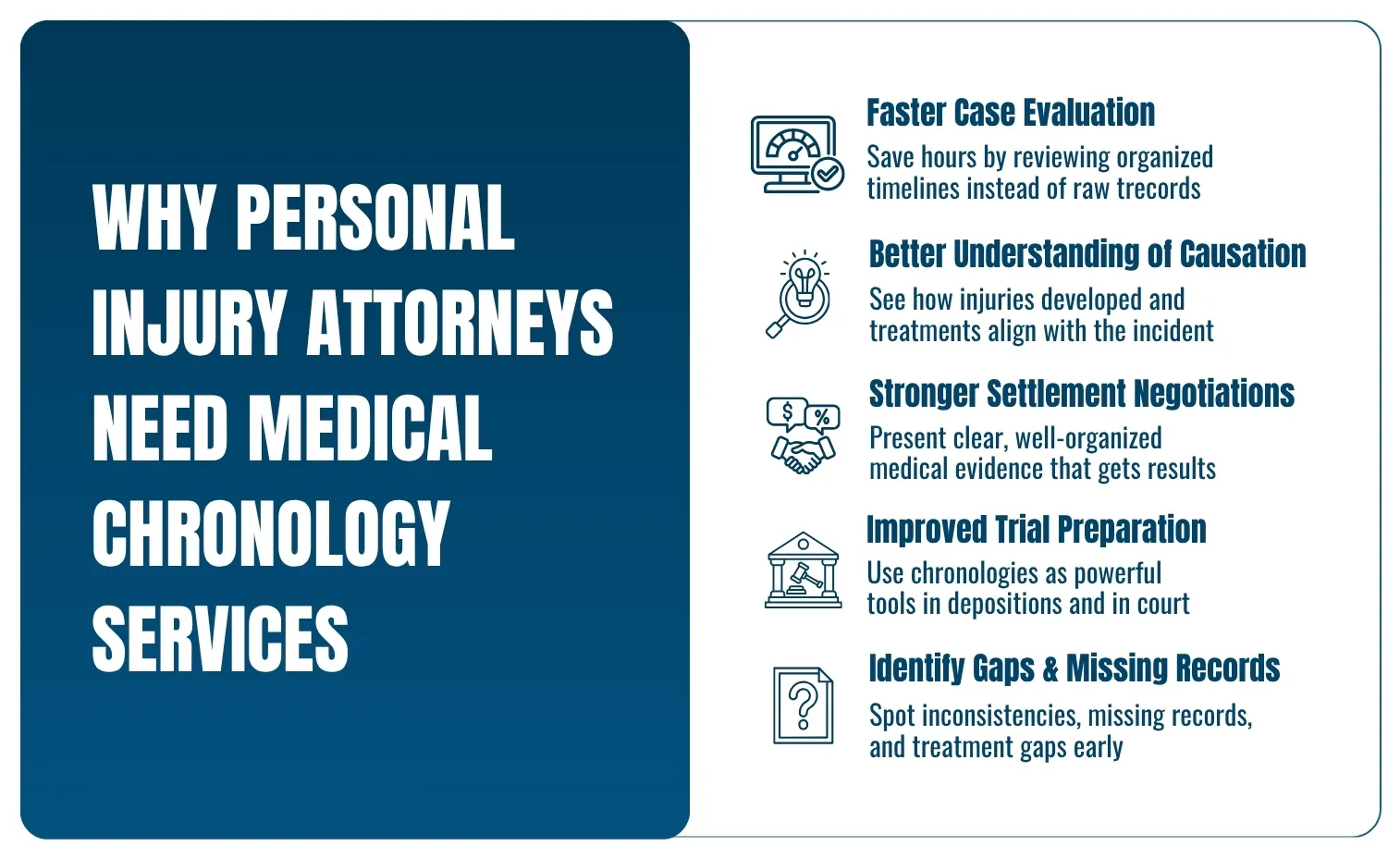
Without structured organization, critical medical details may be overlooked. Medical chronology services address this by enabling:
1. Faster Case Evaluation: Manual review of raw medical records is time-intensive.
Chronologies condense large record sets into organized timelines, allowing attorneys to:
- Assess case strength faster
- Identify critical events quickly
- Improve intake efficiency
- Reduce manual review burden
2. Better Understanding of Causation: Chronological structuring helps attorneys determine:
- When symptoms first appeared
- How injuries progressed
- Whether treatment aligns with the reported incident
- How pre-existing conditions affect the claim
This clarity is essential in establishing causation.
3. Stronger Settlement Positioning: Organized medical timelines improve how evidence is presented to:
- Insurance adjusters
- Opposing counsel
Chronologies help:
- Simplify complex medical narratives
- Highlight treatment consistency
- Support damages analysis
4. Improved Litigation Preparation: Medical chronologies are valuable across:
- Depositions
- Mediation
- Arbitration
- Trial preparation
- Expert witness review
They allow attorneys to quickly reference treatment timelines without repeatedly reviewing full records.
5. Identification of Gaps and Missing Records: Chronologies frequently reveal:
- Missing documentation
- Treatment gaps
- Duplicate entries
- Timeline inconsistencies
Identifying these early helps strengthen case preparation.
Key Components of a Medical Chronology
An effective medical chronology includes:
- Medical Encounter Timeline: Chronological documentation of all provider visits, hospitalizations, and consultations.
- Diagnosis and Treatment History: Tracking how injuries were diagnosed and managed over time.
- Diagnostic Tests and Results: Objective findings that support clinical and legal analysis.
- Physician Notes and Observations: Key clinical insights, recommendations, and assessments.
- Gaps in Care and Missing Records: Identification of inconsistencies or missing data requiring further review.
Medical Chronology vs Medical Summary
| Medical Chronology | Medical Summary |
|---|---|
| Date-based timeline | Narrative overview |
| Tracks every event | Highlights key findings |
| Focus on sequence | Focus on interpretation |
| Used for causation analysis | Used for case understanding |
Many personal injury attorneys use both together for comprehensive case review.
How Medical Chronology Services Work
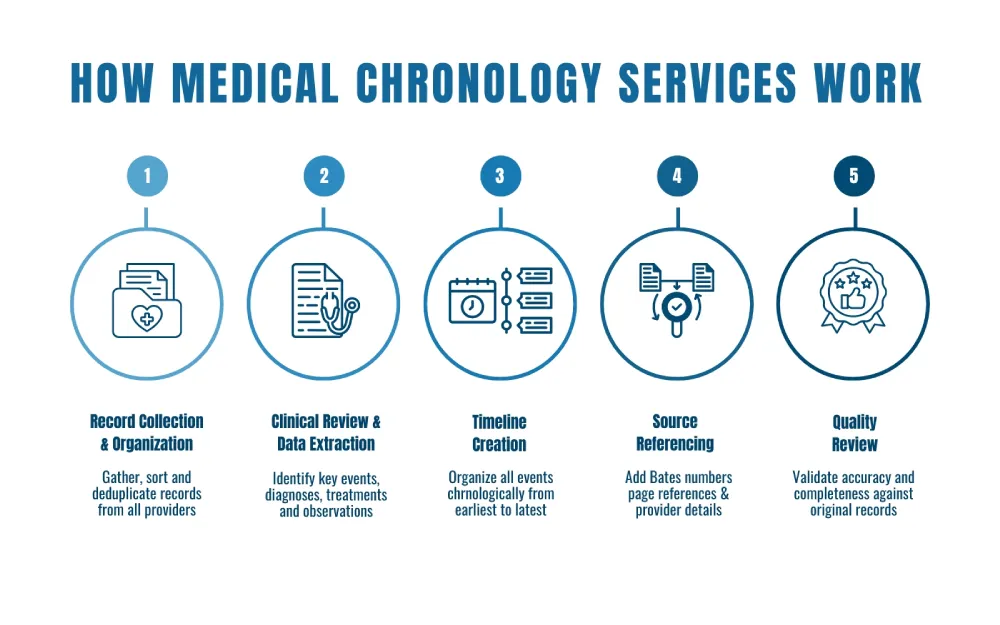
Medical chronology preparation typically follows a structured workflow:
- Record Collection and Organization: Records are collected, sorted, indexed, and deduplicated.
- Clinical Review and Data Extraction: Relevant medical events and details are identified.
- Timeline Creation: Events are organized chronologically.
- Source Referencing and Verification: Page references, provider details, and traceability are added.
- Quality Assurance Review: Final validation ensures accuracy, consistency, and completeness.
When Should Personal Injury Attorneys Use Medical Chronology Services?
Medical chronologies are particularly useful:
- During initial case evaluation
- Before expert review
- While preparing settlement demands
- During trial preparation
Using chronologies early in the case lifecycle helps ensure more consistent and efficient analysis.
How to Choose the Right Medical Chronology Service Provider

Key evaluation factors include:
1. Accuracy and Quality Control
- Reviewer expertise
- Validation workflows
- Clinical oversight
2. HIPAA Compliance and Data Security
- Secure file transfer systems
- Access control mechanisms
- Encrypted workflows
- Compliance-ready processes
3. Turnaround Time
Timely delivery is essential for:
- Litigation deadlines
- Discovery timelines
- Trial preparation
4. Scalability
The provider should support:
- Individual cases
- High-volume litigation
- Ongoing workflows
5. Customization
Look for flexibility in:
- Format
- Detail level
- Reporting style
Why Medical Chronology Services Are Becoming Essential
As medical records become more complex and voluminous, manual review processes become less efficient.
Medical chronology services help legal teams:
- Reduce manual review time
- Improve organization
- Identify insights faster
- Strengthen evidence presentation
For firms managing multiple or complex cases, chronologies are increasingly becoming operational necessities; not optional tools.
Final Takeaway
Effective personal injury case analysis depends on how quickly and accurately medical evidence can be interpreted.
By converting fragmented records into structured timelines, medical chronology services help attorneys improve efficiency, strengthen case strategy, and support more informed legal decision-making.
As litigation complexity continues to increase, medical chronologies are becoming an indispensable part of modern personal injury workflows.