
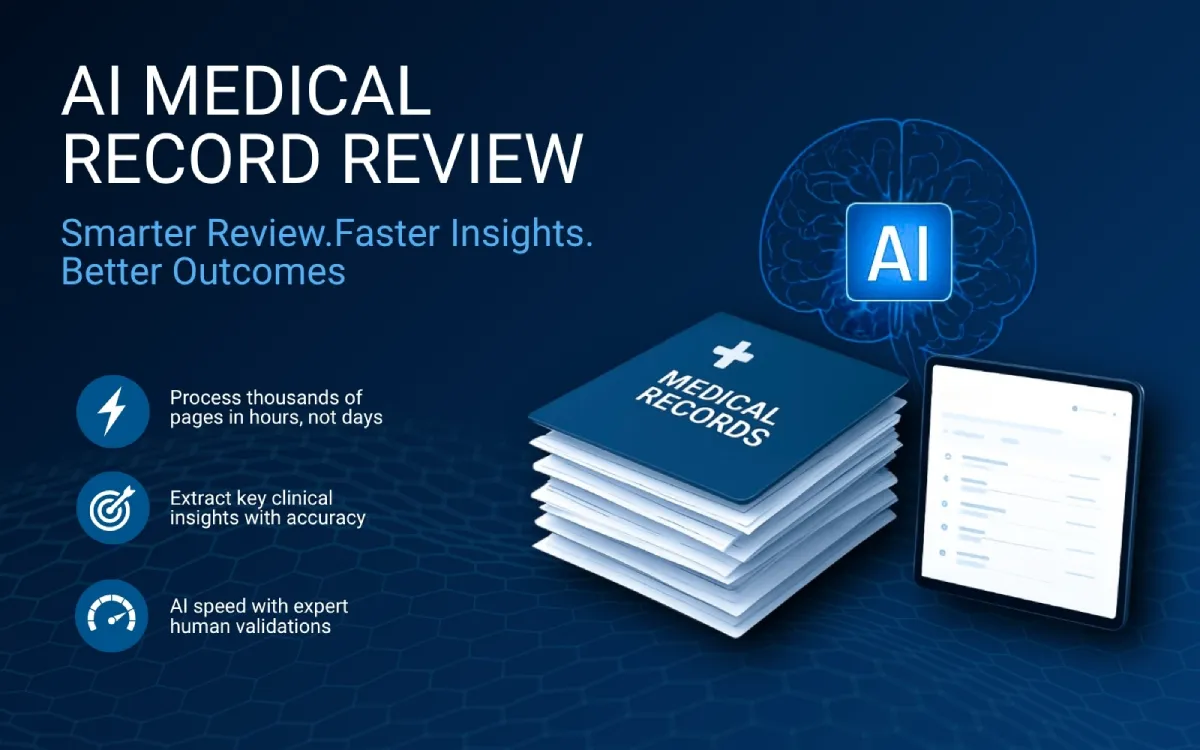
In high-stakes industries such as healthcare, legal services, and insurance, medical records are among the most important sources of information. They document the complete patient care journey — including diagnoses, medications, physician notes, imaging reports, procedures, treatment plans, and outcomes.
However, organizations today face a growing challenge: medical records are becoming increasingly complex, fragmented, and difficult to analyze efficiently.
A single case file may contain thousands of pages spanning:
- Physician notes
- Diagnostic imaging reports
- Laboratory results
- Billing records
- Prescription histories
- Hospital documentation
- Exported electronic health records (EHRs)
Much of this information exists in unstructured formats, making manual review time-consuming, labor-intensive, and prone to inconsistency.
That’s where AI medical record review is changing the game.
Powered by advanced healthcare AI technologies, AI-driven review systems help organizations process, organize, analyze, and summarize medical documentation faster and more accurately than traditional review methods.
From law firms handling personal injury litigation to insurance teams evaluating complex claims, AI-powered review solutions are changing how professionals interact with medical data.
This guide explores:
- What AI medical record review is
- How it works
- Why it matters
- Key outputs generated by AI review systems
- And when organizations should consider using it
What Is AI Medical Record Review?
AI medical record review uses advanced technologies such as:
- Natural Language Processing (NLP)
- Machine Learning (ML)
- Intelligent Character Recognition (ICR)
- Optical Character Recognition (OCR)
to analyze medical documentation and extract clinically relevant information.
Instead of manually reviewing thousands of pages of records, AI-powered systems automatically organize medical data into:
- Structured patient summaries
- Searchable clinical datasets
- Treatment timelines
- AI medical chronologies
- Case-specific insights on diagnoses, procedures, medications, and outcomes
This transformation is especially important because a significant portion of healthcare data exists in unstructured formats such as scanned PDFs, handwritten physician notes, image-based files, and exported electronic health records (EHRs).
AI enables organizations to move beyond document reading and toward intelligent, data-driven decision-making.
Why Traditional Medical Record Review Is So Challenging
Medical records rarely arrive in a standardized or organized format.
A single patient file may include:
- Scanned handwritten physician notes
- PDFs from multiple healthcare providers
- Laboratory and imaging reports
- EHR exports
- Duplicate documentation
- Missing records
- Incomplete treatment histories
- Billing and coding records
Reviewing this information manually can be extremely time-consuming, especially in high-volume environments such as:
- Personal injury litigation
- Medical malpractice claims
- Workers’ compensation disputes
- Insurance claims processing
- Mass tort litigation
In many situations, reviewers spend more time searching for relevant information than analyzing the actual clinical details.
Manual review workflows may also increase the risk of:
- Missed documentation
- Inconsistent interpretation
- Duplicate analysis
- Reviewer fatigue
- Delayed decision-making
How AI Medical Record Review Works
While workflows vary by platform and use case, most AI medical record review systems follow a structured multi-step process designed to improve both speed and accuracy.
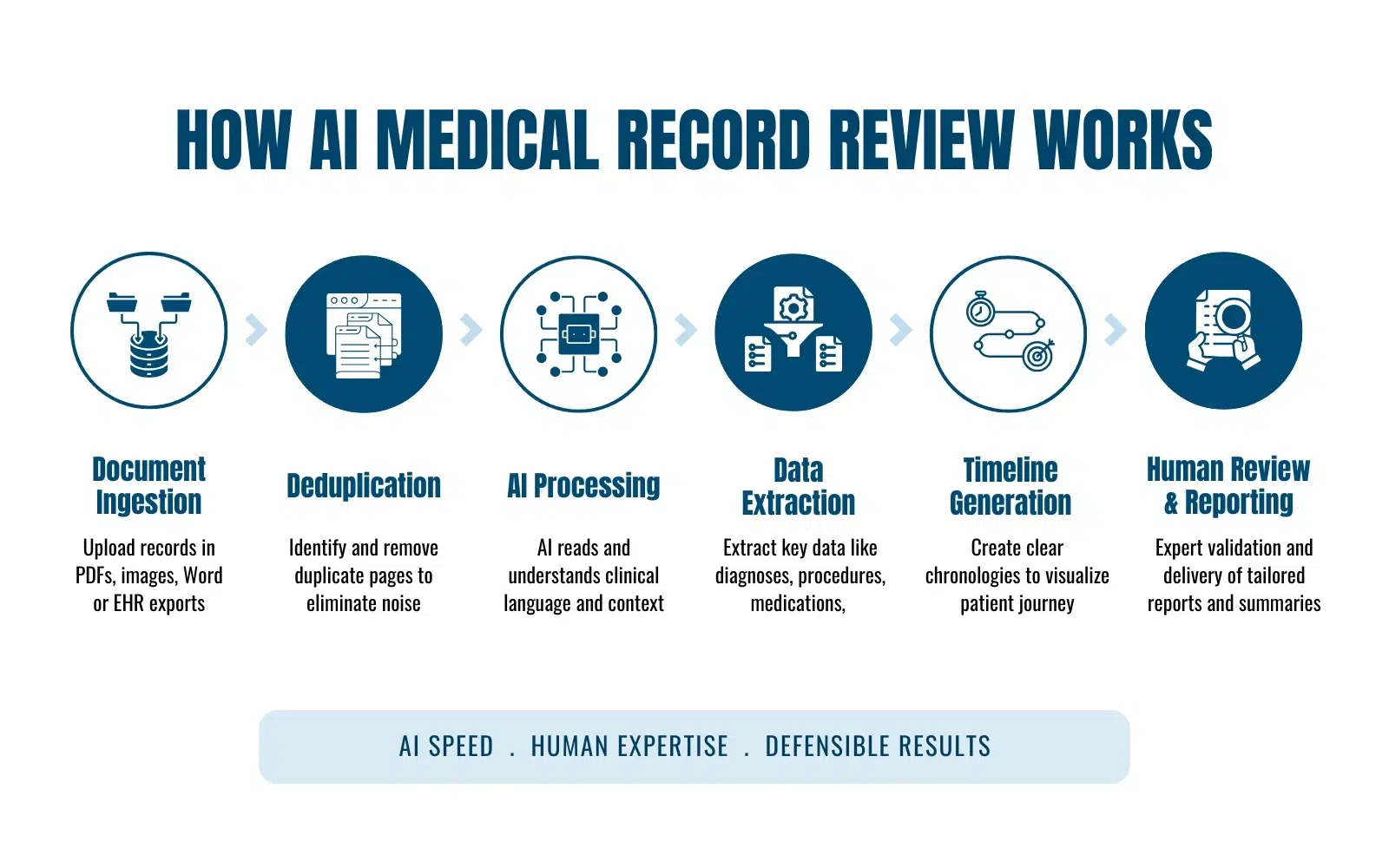
1. Document Ingestion and Deduplication
The process begins with uploading records in formats such as:
- PDFs
- Scanned images
- Word documents
- TIFF files
- Exported electronic health records (EHRs)
At this stage, AI systems identify and remove duplicate records — an especially valuable capability in large and complex case files.
Deduplication helps:
- Reduce review time
- Eliminate redundant analysis
- Improve workflow efficiency
2. AI-based Clinical Language Processing
Once uploaded, records are processed using specialized healthcare AI models trained to understand medical terminology and clinical context.
These systems can:
- Interpret abbreviations and medical jargon
- Identify diagnoses and procedures
- Recognize medications and dosages
- Analyze provider notes
- Read handwritten documentation using intelligent character recognition
Unlike general-purpose AI tools, healthcare-focused systems are designed to distinguish between:
- Confirmed diagnoses
- Suspected conditions
- Ruled-out findings
- Historical medical events
This contextual understanding significantly improves extraction accuracy.
3. Data Extraction and Structuring
The AI system then extracts and organizes clinically relevant information such as:
- Diagnoses and medical conditions
- Treatments and procedures
- Medications and prescription histories
- Laboratory and imaging findings
- Provider encounters
- Dates of service
This information is converted into structured, searchable formats that simplify analysis and navigation.
4. Timeline and AI Medical Chronology Generation
One of the most valuable outputs of AI medical record review is the creation of AI medical chronologies.
These chronologies organize patient data into a clear sequence of medical events, helping users:
- Track treatment progression
- Identify care gaps
- Understand cause-and-effect relationships
- Analyze timelines more efficiently
For legal and insurance professionals, structured chronologies simplify case review and support faster, more informed decision-making.
5. Human-in-the-Loop Validation
Although AI automates much of the processing workflow, expert human oversight remains essential.
Medical professionals and trained reviewers validate AI-generated outputs to ensure:
- Clinical accuracy
- Proper contextual interpretation
- Consistency and completeness
- Defensible reporting quality
This hybrid model, combining AI efficiency with human expertise, helps organizations maintain both scalability and reliability.
6. Reporting and Deliverables
Final outputs are delivered in formats tailored to organizational needs, including:
- Medical summaries
- Case chronologies
- Billing reviews
- Treatment analyses
- Plaintiff fact sheets
- Deposition summaries
Many platforms also provide:
- Hyperlinks
- Bookmarks
- Source references
- Searchable navigation tools
These features improve usability and traceability during legal and insurance review workflows.
Common Outputs Generated by AI Medical Record Review
AI review platforms can generate several useful outputs depending on the use case.
- Medical Chronologies: Structured timelines showing diagnoses, treatments, provider encounters, and key medical events in chronological order.
- Medical Summaries: Condensed overviews highlighting significant clinical findings and treatment history.
- Plaintiff Fact Sheets: Pre-formatted litigation documents commonly used in mass tort and personal injury cases.
- Billing and Chart Reviews: Reports analyzing treatment necessity, coding accuracy, billing patterns, and utilization trends.
- Deposition Summaries: Condensed transcript summaries with citations and references for legal teams.
Key Benefits of AI Medical Record Review
AI-powered record review delivers way more value than just time saving. Key advantages include:
- Faster Turnaround Times: AI can process thousands of pages in hours rather than days, helping organizations meet tight deadlines and improve productivity.
- Improved Organization: Instead of reviewing disconnected records manually, users receive structured summaries and searchable timelines.
- Better Accuracy and Consistency: AI helps reduce oversight risks by consistently identifying relevant medical information across documents.
- Scalability for High-volume Cases: AI enables organizations to manage large litigation, claims, and audit workloads without proportionally increasing staffing requirements.
- Easier Identification of Gaps and Inconsistencies: AI systems can highlight the following: missing records, treatment gaps, conflicting documentation and duplicate information. These insights are particularly valuable during legal and insurance evaluations.
Industries Using AI Medical Record Review
AI-powered medical record review is widely used across multiple industries.
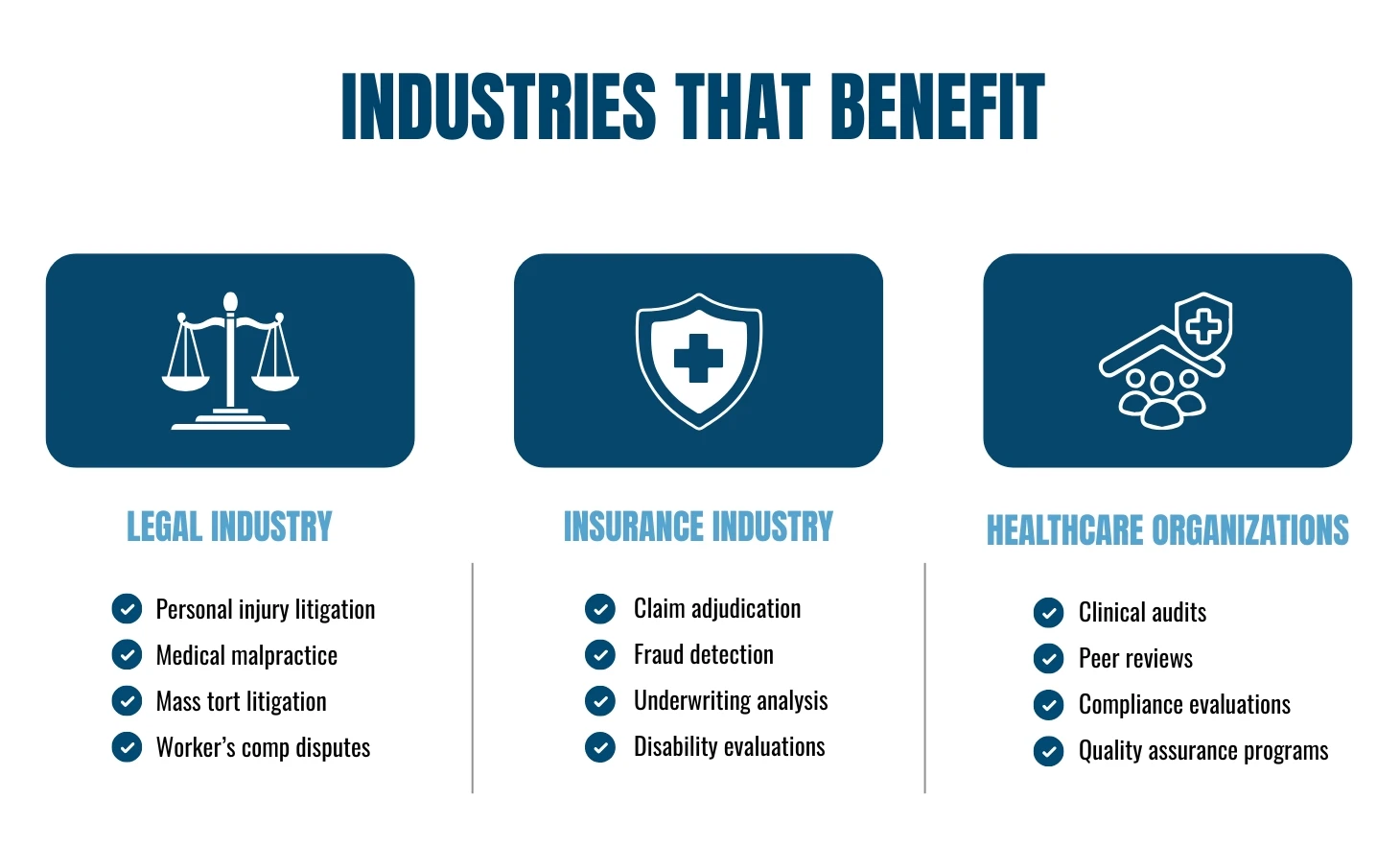
Legal Industry
Law firms use AI medical record review for:
- Personal injury litigation
- Medical malpractice cases
- Mass tort litigation
- Workers’ compensation disputes
Insurance Industry
Insurance organizations use AI-powered review systems for:
- Claims adjudication
- Fraud detection
- Disability evaluations
- Underwriting analysis
Healthcare Organizations
Hospitals and healthcare providers use healthcare AI review tools for:
- Clinical audits
- Peer reviews
- Compliance monitoring
- Quality assurance initiatives
Why AI Medical Record Review Is Becoming Essential for Modern Healthcare and Legal Workflows
Modern healthcare and litigation workflows require faster access to accurate medical insights.
By transforming unstructured healthcare documentation into organized, searchable, and actionable information, AI medical record review helps organizations:
- Reduce manual effort
- Improve operational efficiency
- Enhance review accuracy
- Accelerate decision-making
- Manage high-volume record sets more effectively
As medical data volumes continue to grow, AI-powered review solutions are rapidly evolving from optional tools into essential operational capabilities.
Organizations that combine intelligent automation with expert human oversight are better positioned to handle today’s increasingly complex healthcare, legal, and insurance workflows.