Medical records review is a foundational process that directly impacts care quality, compliance, reimbursement, and risk mitigation. Traditionally, it has required significant administrative effort, with teams navigating vast volumes of complex clinical documentation—often under tight timelines and regulatory scrutiny. As healthcare systems digitize, forward-thinking organizations are adopting AI-powered medical records review to streamline workflows, reduce errors, and enhance decision-making. This shift is redefining how data is extracted, interpreted, and operationalized across the continuum of care.
Partner with us to improve accuracy and speed with AI-powered medical records review.
The Importance of AI in Medical Record Reviews
AI has become essential in record reviews due to the massive volume and growing complexity of healthcare data. Medical professionals are required to analyze extensive patient records daily, a task that traditional review methods-despite digital support-struggle to handle efficiently. AI-driven medical record review solutions offer the speed, flexibility, and accuracy needed to manage this workload effectively.
AI-based review systems leverages advanced technologies such as machine learning, natural language processing (NLP), and data analytics to extract meaningful insights from structured and unstructured clinical data. With the capability to rapidly process large datasets, AI algorithms can detect patterns, highlight critical details, and extract relevant insights that may be missed during manual reviews. This high level of precision is especially vital in areas where accuracy directly affects outcomes, such as medico-legal cases and workers’ compensation claims. Additionally, AI systems continuously evolve by learning from new data, becoming more accurate and reliable over time and delivering sustained long-term value.
Benefits of AI in Medical Records Review
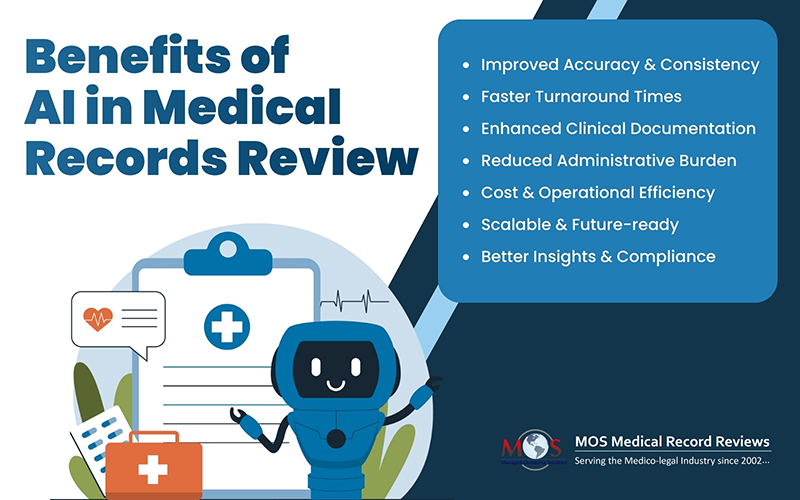
Below discussed are some key benefits of AI in medical records review:
- Improved Accuracy and Consistency: One of the most significant benefits is enhanced accuracy. Manual reviews are susceptible to errors and inconsistencies, especially when dealing with lengthy or fragmented records. AI algorithms apply standardized logic and rules consistently across all records. By minimizing human error, AI ensures that medical records are reviewed with precision, enhancing the reliability of the information provided. By identifying key clinical events, diagnoses, procedures, and timelines, AI medical record review minimizes the risk of missing critical information. This level of precision is particularly valuable in chronic disease management, insurance claims validation, medical-legal reviews, and utilization management.
- Faster Turnaround Times: Speed is another advantage of AI-powered systems. Traditional medical record review processes can take days or even weeks, depending on the volume of records involved. By automating labor-intensive tasks, AI significantly reduces the time required to process medical records, enabling faster service delivery. AI systems can instantly highlight relevant sections, flag anomalies, and generate concise summaries for reviewers. This rapid turnaround enables healthcare providers, insurers, and legal professionals to make timely decisions, improving patient care and operational efficiency.
- Enhanced Clinical Documentation Quality: AI-powered clinical documentation plays a pivotal role in improving the accuracy and completeness of medical records. By intelligently identifying documentation gaps, inconsistencies, and missing clinical details, AI tools help ensure that patient encounters are thoroughly and precisely captured. This not only strengthens the quality of care and supports seamless care continuity but also minimizes the risk of claim denials, audits, and compliance issues. With AI systems integrated into the review process, medical records become more reliable, actionable, and aligned with both clinical and administrative requirements.
- Reduced Administrative Burden: Healthcare professionals often spend a significant amount of their time on administrative tasks rather than patient care. AI in medical records review helps alleviate this burden by automating repetitive and time-intensive processes. Processes such as chart abstraction, coding validation, and data reconciliation can be handled efficiently by AI systems. This allows clinicians and reviewers to focus on higher-value activities and improve productivity.
- Cost Efficiency and Operational Efficiency: Implementing AI-powered review solutions brings substantial cost savings over time, because it streamlines processes and reduces the need for manual intervention. The resulting savings can be strategically redirected to strengthen other high-impact operational areas.
- Scalability and Future Readiness: As healthcare data continues to grow exponentially, manual review processes are no longer sustainable. AI tools for faster medical record review offer scalability that traditional methods cannot match. AI systems can adapt to increasing data volumes without compromising accuracy or speed. Moreover, AI technologies continue to evolve, becoming more intelligent and capable over time. Investing in AI-powered clinical documentation and record review solutions positions healthcare organizations for long-term success in a data-driven healthcare environment.
- Better Insights: AI’s ability to analyze large datasets quickly generates valuable insights that inform strategic decisions. Whether identifying trends in patient data or supporting legal arguments, AI provides actionable intelligence.
- Improved Compliance and Risk Management: Maintaining compliance with regulatory standards is a constant challenge in healthcare. AI-powered medical records review supports compliance by ensuring documentation adheres to required guidelines and coding standards. AI tools can flag potential compliance risks, incomplete records, or discrepancies that may trigger audits. This proactive approach helps organizations mitigate legal and financial risks while maintaining data integrity and security.
Transforming Medical Records Review with AI Technology
AI medical record review is reshaping how healthcare organizations manage and utilize clinical information. From improved accuracy and faster turnaround times to enhanced documentation quality and cost efficiency, the benefits of AI in medical records review are far-reaching. Organizations can reduce administrative burden, improve compliance, and make better-informed decisions. As healthcare continues to evolve, integrating intelligent automation into clinical documentation workflows is no longer a luxury – it is a strategic necessity for delivering high-quality, efficient, and sustainable healthcare services.
Explore AI-powered medical records review solutions today.
Get Started Now.