
In high-stakes legal, insurance, workers’ compensation, and healthcare cases, decisions often depend on what is hidden inside thousands of pages of medical records. A missed diagnosis. An overlooked treatment gap. An undocumented pre-existing condition. A forgotten medication interaction.
Any of these details can significantly influence case outcomes, financial exposure, settlement values, reimbursement decisions, or patient care strategies.
Traditionally, reviewing medical records has been a labor-intensive process requiring skilled professionals to sift through extensive documentation. While expert reviewers remain indispensable, the sheer volume and complexity of modern healthcare records have created a new challenge: information overload.
This is why AI-driven medical record review has evolved from an operational advantage into a strategic necessity.
Organizations that combine advanced AI capabilities with expert clinical review are achieving faster turnaround times, deeper insights, greater consistency, and improved decision-making–particularly in high-value, high-risk cases.
Key Takeaways
- AI medical record review helps organizations analyze large volumes of clinical data faster.
- Human-in-the-loop review combines AI efficiency with expert clinical judgment.
- AI can accelerate chronology creation, case summarization, and evidence identification.
- Legal, insurance, workers’ compensation, and healthcare organizations are increasingly adopting AI-assisted medical record review services.
- Organizations using AI strategically can improve speed, consistency, and decision-making in complex cases.
What Is AI-driven Medical Record Review?
AI-powered chart review uses advanced technologies such as:
- Natural Language Processing (NLP)
- Machine Learning (ML)
- Large Language Models (LLMs)
- Intelligent Data Extraction
- Clinical Entity Recognition
to analyze structured and unstructured medical data.
Rather than manually reading every page, AI systems can rapidly:
- Extract diagnoses
- Identify medications
- Detect treatment timelines
- Highlight procedures
- Surface critical events
- Generate chronologies
- Flag inconsistencies
- Create concise summaries
Human clinical experts then validate, interpret, and contextualize the findings. This human-in-the-loop approach combines the speed of automation with the judgment and expertise that high-stakes cases demand.
GetAI-driven medical record review customized for your requirements.
The Growing Challenge of Medical Data Volume
Healthcare data is expanding at an unprecedented pace. A single complex personal injury, workers’ compensation, or disability claim can involve:
- Hospital records
- Physician notes
- Diagnostic reports
- Laboratory results
- Imaging studies
- Pharmacy records
- Rehabilitation documentation
- Insurance correspondence
In many cases, reviewers must analyze thousands, or even tens of thousands of pages. The challenge is not merely volume. It is identifying the few critical facts that determine case strategy, liability, causation, treatment appropriateness, claim validity, or future medical needs.
AI excels at finding these patterns within massive datasets. This makes AI-powered medical record review for personal injury litigation and other legal cases very significant.
Research also shows growing healthcare adoption of AI technologies. A 2025 survey found that 22% of healthcare organizations had already implemented domain-specific AI tools, representing a significant increase from previous years.
Why AI-driven Medical Record Review Is Important for High-stakes Cases
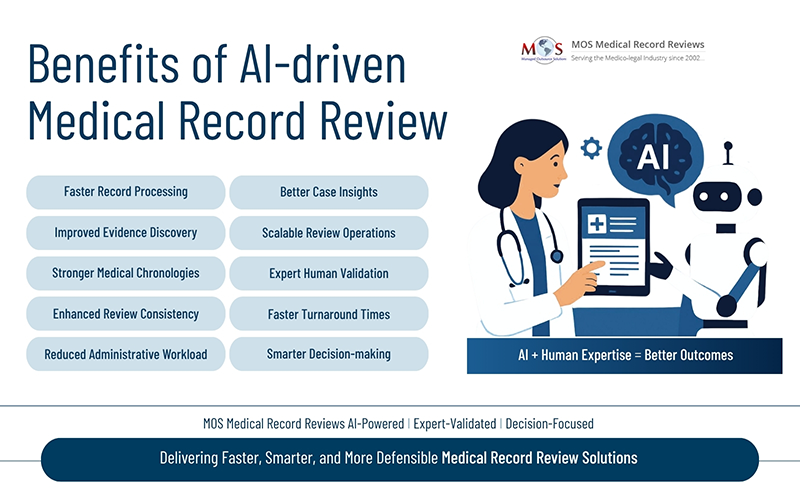
- Faster Access to Critical Medical Evidence
In litigation, insurance claims, and utilization reviews, delays can be costly. Traditional manual healthcare data review often requires days or weeks to process large record sets.
AI-powered medical record review services for insurance claims and legal cases can rapidly:
- Organize records
- Extract key clinical facts
- Build timelines
- Categorize diagnoses
- Highlight significant events
Benefits of AI medical record summarization for attorneys are significant. It enables attorneys, insurers, and healthcare professionals to focus on strategy rather than data gathering. The result is faster case progression and more informed decisions.
- Improved Detection of Hidden Patterns
Complex medical cases rarely reveal their full story through isolated documents. Important insights often emerge only when records are analyzed collectively.
AI systems can identify:
- Treatment gaps
- Recurring symptoms
- Provider inconsistencies
- Duplicate services
- Medication conflicts
- Chronic condition progression
- Unexpected utilization trends
These findings may significantly impact case evaluation and risk assessment.
- Enhanced Accuracy through Consistency
Human reviewers are highly skilled, but fatigue and information overload are unavoidable realities when reviewing thousands of pages. AI brings consistency to repetitive analytical tasks by:
- Applying standardized review logic
- Maintaining uniform extraction criteria
- Reducing manual oversight risks
- Ensuring comprehensive data coverage
Expert human review remains essential, but AI helps reduce the likelihood of critical information being overlooked.
- Stronger Case Chronologies
One of the most valuable outputs in legal and insurance review is a clear medical chronology.
A well-constructed timeline helps stakeholders understand:
- What happened
- When it happened
- How treatment evolved
- Whether symptoms changed
- How causation may be established
AI dramatically accelerates chronology creation by extracting and organizing clinical events across multiple sources. Instead of reviewing hundreds of pages manually, professionals can focus on analyzing the resulting timeline and its implications.
- Better Decision-making under Time Pressure
Many high-stakes decisions must be made quickly.
Examples include:
- Settlement evaluations
- Workers’ compensation reviews
- Catastrophic injury assessments
- Disability determinations
- Fraud investigations
- Utilization reviews
- Medicare Set-Aside evaluations
AI-supported reviews enable stakeholders to access actionable insights earlier in the decision-making process. This speed can create significant strategic advantages.
The Human-in-the-Loop Advantage
A common misconception is that AI replaces medical reviewers. In reality, the most effective solutions combine:
AI Strengths
- Speed
- Scalability
- Pattern recognition
- Data extraction
- Automation
Human Strengths
- Clinical judgment
- Contextual interpretation
- Nuanced reasoning
- Legal defensibility
- Quality assurance
This hybrid model like ReviewGenX delivers the best outcomes. Industry experts increasingly emphasize that trust and reliability improve with the use of human-in-the-loop AI medical record review solutions. Here, AI-generated findings are reviewed and validated by qualified professionals rather than used independently.
AI’s Role in Legal and Insurance Medical Record Review
Personal Injury Litigation
AI helps identify:
- Injury timelines
- Prior medical history
- Treatment progression
- Future care indicators
- Causation-related evidence
Workers’ Compensation Cases
AI can rapidly surface:
- Work-related injuries
- Functional limitations
- Treatment compliance
- Return-to-work milestones
Insurance Claims Review
AI supports:
- Medical necessity reviews
- Fraud detection
- Utilization analysis
- Claims validation
Medicare Set-Aside (MSA) Preparation
AI assists reviewers by organizing historical treatment data and identifying future care considerations, allowing experts to focus on allocation accuracy and compliance requirements.
Key Benefits Organizations Are Realizing
Organizations adopting AI-powered review solutions are experiencing:
Operational Benefits
- Faster turnaround times
- Improved productivity
- Reduced administrative burden
- Better resource utilization
Clinical Benefits
- Enhanced record visibility
- Improved data consistency
- Better documentation insights
Strategic Benefits
- Stronger risk management
- More informed decisions
- Greater competitive advantage
- Improved scalability
Healthcare leaders increasingly view AI as a solution for reducing documentation burdens and improving operational efficiency. Studies continue to show growing interest in AI-assisted documentation and administrative workflows across healthcare organizations.
Emerging Trends Shaping the Future of Medical Record Review
The next generation of AI-driven review platforms is expected to deliver:
Predictive Insights
Identifying likely future medical utilization patterns and treatment trajectories.
Conversational Review Interfaces
Allowing reviewers to ask questions such as:
“Show all records related to lumbar spine treatment between 2022 and 2024.”
Multimodal Analysis
Reviewing clinical notes, diagnostic images, lab data, and structured records together.
Real-time Case Intelligence
Providing ongoing updates as new records are received.
Advanced Medical Summarization
Generating increasingly sophisticated case summaries while preserving clinical accuracy.
Why Strategic Organizations Are Acting Now
AI adoption in healthcare has moved beyond experimentation. A 2025 survey of U.S. hospitals reported that approximately 31.5% were already using generative AI technologies, with many more planning implementation. The question is no longer whether AI will transform medical record review. The question is which organizations will leverage it effectively while maintaining the human expertise necessary for defensible, high-quality outcomes.
For legal teams, insurers, healthcare organizations, and third-party administrators, AI-driven medical record review represents a powerful opportunity to improve speed, consistency, and insight without sacrificing accuracy.
In high-stakes cases, where every detail matters, that advantage can be decisive.
FAQs
What is AI-driven medical record review?
AI-driven medical record review uses artificial intelligence technologies to analyze medical records, extract key information, identify patterns, and generate summaries or chronologies that support clinical, legal, and insurance decision-making.
Does AI replace human medical reviewers?
No. The most effective approach combines AI automation with expert clinical review. AI accelerates data processing, while qualified professionals provide interpretation, validation, and quality assurance.
How does AI improve medical record review accuracy?
AI helps reduce information overload, applies consistent extraction methods, and identifies relevant data across large record sets. Human reviewers then verify findings and provide contextual analysis.
Which industries benefit from AI-powered medical record review?
Legal firms, insurance carriers, workers’ compensation administrators, healthcare providers, independent review organizations, and Medicare Set-Aside professionals all benefit from AI-assisted review processes.
Is AI-driven medical record review secure?
When implemented properly, AI review solutions can operate within HIPAA-compliant and privacy-focused frameworks designed to protect sensitive healthcare information.
Conclusion
As medical records become larger, more complex, and more critical to decision-making, organizations can no longer rely solely on traditional review methods.
AI-driven medical record review empowers legal, insurance, and healthcare professionals to uncover critical insights faster, improve review consistency, and make more informed decisions in high-stakes cases.
The future belongs not to AI alone, but to the strategic combination of advanced technology and expert human judgment. Organizations that embrace this model today will be better positioned to navigate the increasing complexity of tomorrow’s healthcare and legal landscape.
Need faster, more accurate medical record reviews?
Contact us today to learn how our AI-assisted review solutions can help you manage complex cases with greater confidence.