
Attorneys regularly handle cases that involve extensive medical documentation. Personal injury claims, medical malpractice cases, and workers’ compensation disputes can include records from multiple providers, diagnostic reports, treatment notes, and clinical documentation. Traditional methods of sorting, indexing, and summarizing thousands of pages can be a significant operational bottleneck for legal firms aiming to maintain a competitive edge.
To manage this complexity, legal teams rely on AI medical chronologies. AI-assisted chronologies analyze complex medical documentation, extract key data points, and structure information into organized timelines. Automated chronology systems simplify case analysis, support deposition preparation, and help legal teams quickly understand the progression of a patient’s care. This is where many firms turn to AI-powered medical chronology services to organize and interpret large volumes of medical records efficiently.
Challenges in Traditional Medical Chronology Preparation for Litigation Support Teams
Creating medical chronologies presents several operational challenges for litigation support teams. Case files may include thousands of pages collected from multiple providers, facilities, and specialties. Manually reviewing and summarizing relevant medical events from this material is time-intensive, error-prone, and highly detail-oriented.
Some of the common challenges include:
- High document volume: Medical records may span several years of treatment and include hospital notes, specialist consultations, diagnostic reports, and therapy documentation.
- Time-intensive review processes: Analysts have to read through extensive documentation to locate treatment dates, procedures, and clinical findings.
- Fragmented information sources: Records from different providers may be formatted inconsistently, making it difficult to assemble a clear treatment timeline.
- Risk of overlooked details: When large volumes of information are reviewed manually, important clinical references or supporting notes may be missed, which can lead to incomplete or conflicting interpretations.
- Resource constraints: Litigation providers handling multiple cases simultaneously may struggle to maintain consistent turnaround times.
Artificial intelligence helps address these bottlenecks using technologies such as machine learning, natural language processing (NLP), and intelligent character recognition (ICR). These capabilities support faster document processing and streamline litigation preparation, improving overall workflow efficiency.
How Artificial Intelligence Automates Medical Chronology Development for Legal Cases
Automated Identification of Medical Data
One of the most time-consuming aspects of medical chronology preparation is locating discrete clinical details across hundreds or thousands of pages of records. AI systems can automatically scan voluminous medical documentation and extract key medical data such as:
- Treatment dates and provider encounters
- Diagnoses and documented medical conditions
- Surgical procedures and clinical interventions
- Medication references and prescription histories
- Imaging studies, laboratory testing, and diagnostic reports
Surfacing these details early in the review process reduces the need for manual page-by-page review.
Intelligent Chronological Structuring
After extracting relevant medical data, AI systems can organize these events into chronological timelines. These timelines present medical information in sequence, giving litigation teams a structured foundation for case analysis.
This structured timeline helps reviewers quickly pinpoint critical case details, such as:
- When symptoms first appeared
- How treatment evolved over time
- Which providers were involved in key stages of care
- Whether follow-up care occurred within expected timeframes
Organizing treatment events in sequence enables legal teams to assess injury progression, treatment history, and provider interactions. This structure supports deposition preparation, expert review, and case strategy discussions.
Highlight Patterns and Inconsistencies
Beyond organizing information, AI-assisted review tools can also help highlight patterns or inconsistencies within medical records. These may include:
- Repeated treatments across multiple providers for the same condition
- Variations in documented diagnoses over time
- Significant gaps between reported incidents and subsequent medical visits
- Overlapping or conflicting treatment notes from different facilities
Attorneys can leverage these AI-driven insights to improve the speed, accuracy, and consistency of case evaluations. When key events and discrepancies within the chronology are surfaced, experts can better evaluate medical context that may influence liability, causation, or damages.
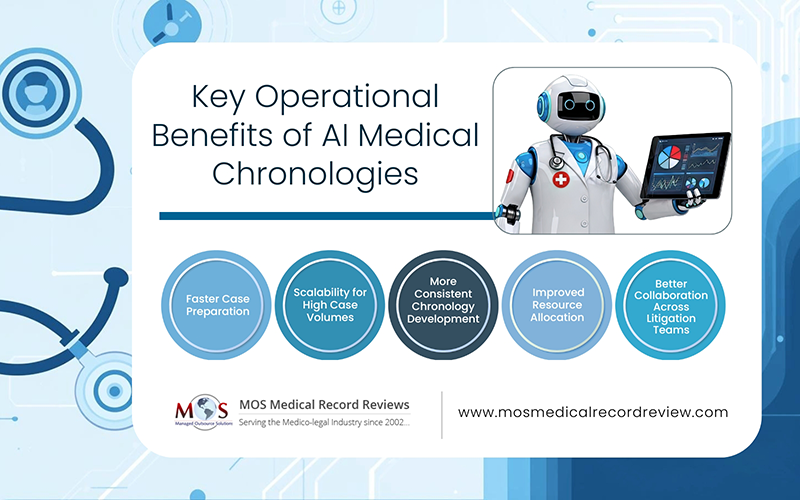
Key Operational Benefits of AI Medical Chronologies for Litigation Providers
Efficient case preparation depends on how quickly litigation teams can interpret complex medical documentation and translate it into actionable insights. AI medical chronologies support this process by accelerating record analysis, organizing critical information, and helping legal teams work with structured medical timelines. Key operational benefits include:
- Faster Case Preparation: AI-powered chronology systems reduce the time required to review and organize extensive medical record sets. By extracting and organizing treatment events, litigation teams can begin case analysis sooner and prepare timelines for attorneys and experts more quickly.
- Scalability for High Case Volumes: Litigation providers frequently manage multiple cases involving extensive medical documentation. AI-enabled chronology tools help teams process larger volumes of records without proportionally increasing staffing requirements.
- More Consistent Chronology Development: Standardized data extraction and structured timelines help maintain consistency across cases. This improves the reliability of chronologies prepared for attorneys, experts, and insurance stakeholders involved in litigation review.
- Improved Resource Allocation: AI-supported chronology preparation helps litigation providers allocate their teams more strategically. Instead of spending large amounts of time on manual record sorting and data extraction, analysts and medical reviewers can focus on higher-value activities such as case interpretation, expert coordination, and litigation strategy development.
- Better Collaboration across Litigation Teams: Structured medical timelines allow attorneys, paralegals, medical reviewers, and expert witnesses to work from the same organized view of the patient’s treatment history. This supports clearer communication during case analysis, deposition preparation, and expert review.
By streamlining record analysis and organizing medical events into clear timelines, AI medical chronologies help litigation providers operate more efficiently while maintaining the level of accuracy required for complex legal cases.
Why Human Expertise Remains Essential in AI-assisted Medical Chronologies
While AI significantly improves the speed and organization of medical chronology preparation, human expertise remains essential for accurate case interpretation. Medical reviewers and legal analysts provide the clinical context needed to understand complex treatment histories, evaluate causation, and identify information that may influence litigation strategy. Human oversight also determines which clinical events are legally significant and how those events should be presented to support case strategy. This interpretive role ensures that AI-generated timelines are transformed into meaningful litigation insights rather than just structured data.
Why Collaborate with MOS Medical Record Reviews
Effective medical chronology preparation requires both advanced technology and experienced review professionals. MOS Medical Record Reviews brings these capabilities together to support attorneys and their legal teams that need to handle complex medical documentation.
What sets MOS apart:
- AI-driven record analysis: Advanced tools help process large volumes of medical records and identify critical clinical information efficiently.
- Expert medical review teams: Experienced analysts ensure chronologies reflect the clinical and legal context relevant to each case.
- Litigation-focused outputs: Chronologies are structured to support attorneys, claims professionals, and expert witnesses during case evaluation and deposition preparation.
- Reliable turnaround times: Streamlined processes help legal teams access organized medical timelines when they need them.
By combining AI-assisted analysis with expert oversight, MOS helps litigation providers transform complex medical documentation into structured chronologies that support efficient case preparation.
Strengthening Litigation Workflows with AI Medical Chronologies
As litigation cases continue to involve larger volumes of medical documentation, the ability to organize and interpret this information efficiently has become increasingly important for legal teams. AI medical chronologies help address this challenge by accelerating record review, structuring complex clinical data, and supporting faster case preparation.
Integrating AI legal case chronology development can improve workflow efficiency, enhance collaboration, and enable teams to handle high case volumes more effectively. When combined with human expertise, AI-assisted chronologies provide a practical approach to manage complex medical evidence while supporting more informed litigation strategies.
Simplify Medical Record Analysis for Legal Cases.
Benefit from MOS’s AI-powered medical chronology services.