
Did you know that a whopping 750,000+ Medicare beneficiaries are involved in workers’ compensation cases annually, and each claim requires meticulous medical record review before a Medicare Set-Aside (MSA) can be approved?
Now imagine reviewing all of that manually; while ensuring nothing goes missing, compliance stays intact, red flags are captured, and future medical costs are accurately projected with zero errors.
This is where Artificial Intelligence (AI) comes into the fore.
As MSAs continue to grow in complexity, organizations are rapidly turning towards adopting AI for Medicare Set-Asides and AI-powered medical record review is emerging as the game-changer that workers’ compensation carriers, attorneys, claims professionals, and MSA vendors didn’t know they needed.
Why Is Medical Record Review for MSAs Inherently Complex?
Before we break down how AI improves medical record review for MSAs, let’s understand why MSA record reviews have always been uniquely challenging.
- Fragmented Documentation
Claimants often seek treatment from multiple providers over years. This opens up possibilities of:
- Duplicate records
- Missing documentation
- Conflicting diagnoses
- Illegible handwritten notes
- Volume & Variability
A single MSA may include:
- Physician office visits
- ER notes
- Imaging reports
- Operative reports
- Pharmacy histories and more.
Each case follows a different format, language and tone.
- Risk of Allocating Incorrectly
MSA allocations require:
- Confirming compensable vs. non-compensable conditions
- Identifying future medical needs
- Determining ongoing medication costs
- Ensuring CMS compliance
One oversight can cause:
- CMS rejections
- Settlement delays
- Financial liability
- Time-intensive Manual Reviews
Traditional medical record review requires hours or even days per case. With rising claim loads, manual processes simply can’t keep up.
AI Is Redefining How Medical Records Are Reviewed for Medicare Set-Asides
- AI Automates and Accelerates Record Ingestion
Manual intake typically involves sorting, labeling, merging duplicates, identifying missing pages, and organizing documents chronologically—all of which are susceptible to errors.
AI changes the game through:
- Automated file classification (progress notes, imaging, lab reports, etc.)
- OCR-based extraction of handwritten or scanned content
- Deduplication of identical records, and even data
- Gap detection (highlighting discrepancies like missing documents)
- Automatic chronology building
With automated medical record review, the process that once took several hours can now be completed in a matter of a few minutes.
- Intelligent Clinical Extraction for MSA-relevant Data
Unlike generic automation, AI can be trained specifically for MSA needs.
It can identify and extract:- Diagnoses
- Comorbidities
- Surgical procedures
- Medications (current and discontinued)
- Treatment frequency
- Functional limitations
Provider notes indicating future medical needs
This ensures no critical detail is overlooked, especially compensable vs. non-compensable conditions that can impact final allocations.
- Medication Analysis & Opioid Monitoring
Prescription medications are one of the most scrutinized components of an MSA.
AI tools can:
- Identify all medications (past, current, duplicated)
- Link them to relevant diagnoses
- Flag opioid prescriptions, polypharmacy, or inappropriate long-term drug use
- Track discontinuations vs ongoing medications
- Provide cost projections based on CMS pricing models
This dramatically improves accuracy in AI for MSA compliance and Part D allocations.
- Predictive Models for Future Treatment Costs
Future medical cost projection is the centerpiece of MSA preparation.
With AI, predictions are not based solely on past data, as they leverage national trends, treatment patterns, and clinical benchmarks.
AI-powered cost models can evaluate:
- Treatment longevity
- Expected frequency of physician visits
- Likely surgeries
- Durable medical equipment needs
- Ongoing therapy requirements
This leads to future care projections that are both data-driven and CMS-aligned.
- Built-In Compliance Intelligence
CMS has strict guidelines for:
- Rated ages
- Life expectancy
- Prescription drug references
- Standard pricing
- Treatment justification
AI ensures compliance by:
- Auto-flagging missing compliance elements
- Cross-checking medications with CMS formularies
- Highlighting discrepancies between clinical documentation and MSA recommendations
This reduces the risk of re-submission or rejection.
- Natural Language Processing (NLP) for Deep Review
NLP, the tech-brain behind contextual understanding, can comb through thousands of pages and translate medical documentation like a seasoned reviewer in a matter of minutes.
NLP can identify:- Causation statements
- Maximum medical improvement (MMI) references
- Provider recommendations
- Return-to-work restrictions
- Prognosis
- Whether a condition is unrelated or denied
This context extraction is one of the most powerful AI contributions to MSA workflows.
- AI Improves Reviewer Efficiency
Let’s get this straight: AI doesn’t replace clinical reviewers; it augments them. By handling repetitive administrative tasks, AI enables MSA specialists to focus on:
- Complex clinical judgment
- Validation of extracted data
- Decision-making for allocations
- Case-level insights
This combination of AI + human expertise leads to unmatched precision.
- Enhanced Quality Control and Audit Trails
AI systems provide built-in audit trails, including:
- Timestamped actions
- Data-source mapping
- Origin of extracted information
- Reasons for clinical flags
This provides the transparency invaluable for legal, insurance, and CMS review purposes.
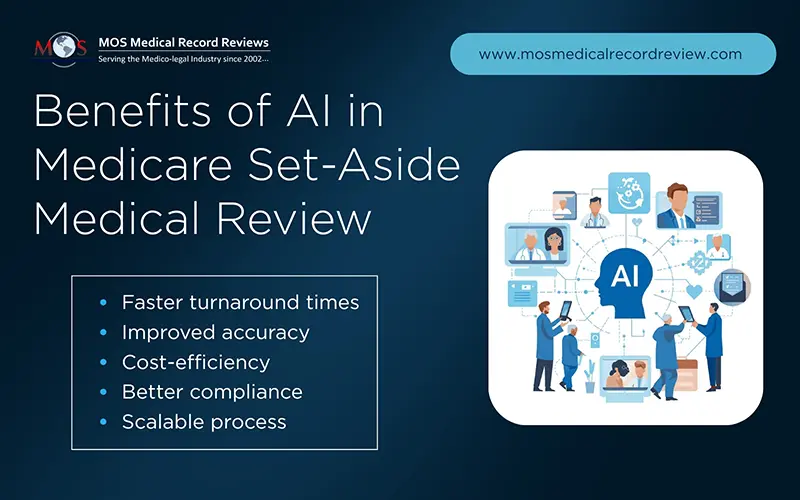
What Are the Benefits of AI in Medicare Set-Aside Medical Review?
- Faster turnaround times: With 60-70% reduction in processing time, it is ideal for cases requiring quick settlement.
- Improved accuracy: AI catches inconsistencies, omissions, and clinical nuances that humans might miss during manual reviews.
- Cost-efficiency: Automated record sorting, data extraction, and medication review significantly reduce operational costs.
- Better compliance: CMS-aligned review workflows reduce the risk of rejection.
- Scalable process: Whether handling 10 cases or 10,000, AI scales effortlessly.
Real-time Use Cases of AI in MSA Cases
- Workers’ Compensation Carriers
Carriers can accelerate high-volume claims processing while improving allocation consistency.
- Legal Firms
Attorneys preparing for settlement negotiations get clearer medical insights faster.
- MSA Vendors
AI gives vendors an edge by enabling more accurate, defensible, and transparent allocations.
- TPAs & Case Managers
Improve claim timelines, reduce administrative overhead, and support better decision-making.
Why AI-enabled Medical Record Review Is the Future of MSAs
The MSA landscape is evolving, and CMS is increasingly expecting objective, well-documented, and clinically justified allocations.
AI gives stakeholders:
- Speed
- Quality
- Compliance
- Scalability
In an industry where delays cost money and inaccuracies invite liability, AI is shifting MSA workflows from reactive to proactive, from manual to augmented, and from labor-heavy to intelligence-driven.
Why Collaborate with MOS for AI-powered MSA Medical Record Review
Managed Outsource Solutions (MOS) blends cutting-edge AI record review capabilities through our advanced AI validation engine ReviewGenX, along with seasoned clinical and legal expertise to deliver unmatched value in MSA medical record review.
Here’s what makes MOS your ideal partner:
- Specialized AI Models Built for MSA Needs
- Hybrid Human-AI Approach for 100% Accuracy
- Deep Expertise in Workers’ Compensation, Liability & Disability Records
- Faster TAT without Compromising Quality.
- Transparent, Audit-friendly Outputs
Final Thoughts
AI is no longer just an operational upgrade; it’s a strategic advantage for anyone involved in preparing Medicare Set-Asides. By automating tedious tasks, extracting clinically relevant data with precision, projecting future medical needs, and supporting airtight CMS compliance, AI transforms medical record review from a slow, error-prone process into a streamlined, insight-driven workflow.
For organizations aiming to reduce settlement delays, improve allocation quality, and manage claim volumes with confidence, AI-powered medical record review isn’t just the future—it’s the new standard. And with MOS combining advanced AI capabilities with decades of medical-legal expertise, you gain a partner that ensures every MSA is built on clarity, compliance, and clinical intelligence.